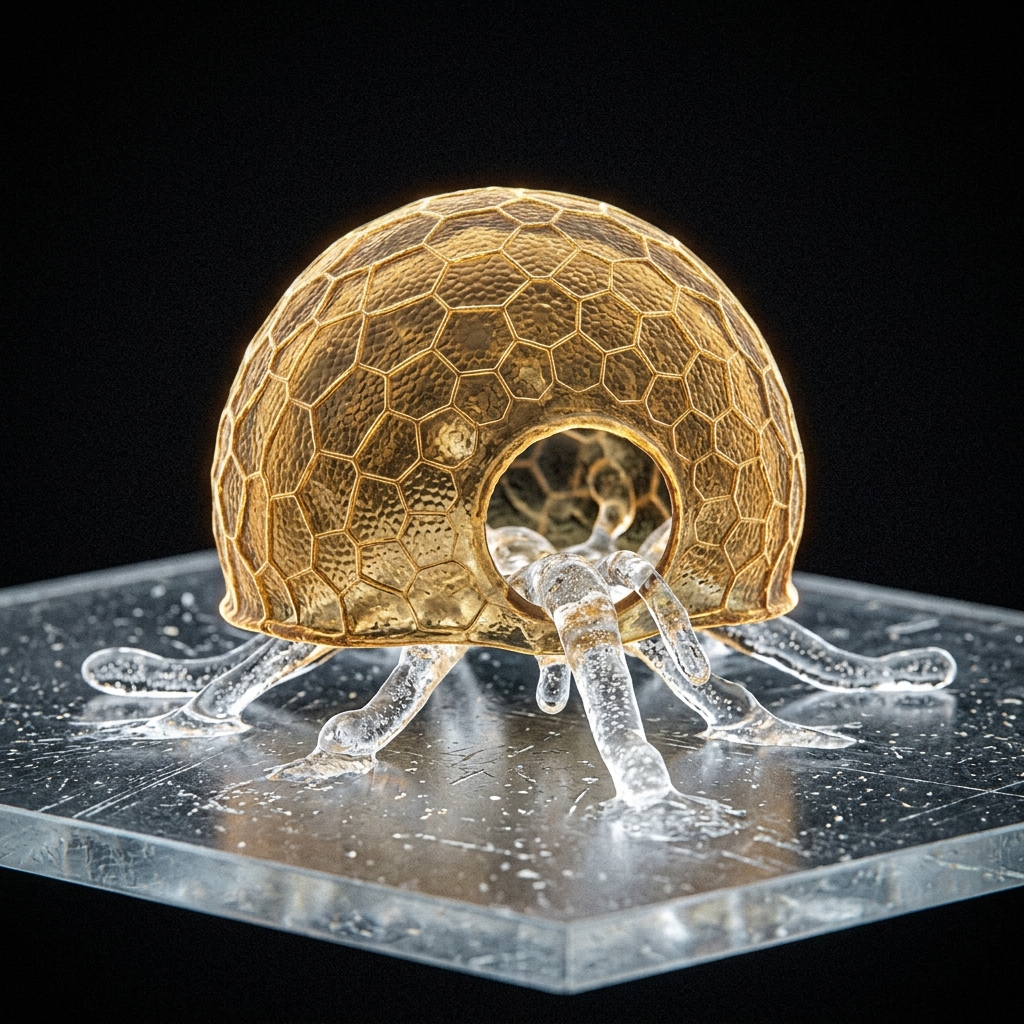
 Figure 1: Arcella extending several transparent, finger-like "pseudopodia" from the central opening of its chitinous dome-shaped shell (test) (*Image is for illustrative purposes only)
[!NOTE] *All microorganism images used in this article are 3D CG illustrations.
🎯 Quick Summary & FAQ (Key Takeaways)
Before we dive into the detailed guide, here are quick answers to the most common questions.
Q. Where can I find Arcella? A. They are commonly found on the surface of aquatic plants in shallow ponds or lakes, as well as in damp mosses in wetlands. Unlike their cousin Difflugia, which crawls in the bottom mud, Arcella prefers relatively oxygen-rich environments such as the spaces between water plant leaves and wet mosses.
Q. What is the biggest difference between Arcella and Difflugia? A. Arcella secretes its own shell (test) internally instead of gluing external sand grains. While Difflugia builds a shell by cementing sand grains together with organic glue, Arcella synthesizes its own organic plates (made of a chitin-like substance) within the cell and secretes them to construct a neat, dome-shaped shell.
Q. What is the hole at the bottom of the shell for? A. It is the “pylome” (or pseudostome), the only opening from which they extend their pseudopodia. Through this circular opening at the center of the flat underside, Arcella extends transparent, finger-like pseudopodia to crawl and capture food. They can also generate gas bubbles (vacuoles) inside the shell to float and migrate in the water column.
🔬 1. Arcella Biology and the Unique “Organic Test” Formation
When observing aquatic plants under a microscope, you may find neat circular shells resembling miniature straw hats or donuts. These are Arcella (scientific name: Arcella, commonly known as testate amoebae).
The Geometric Dome and Color Changes with Age
The most captivating feature of Arcella is its highly organized, self-secreted shell and how its color changes over time.
- Self-Secretion of Organic Plates: Arcella does not use external materials like sand. It synthesizes small circular or hexagonal organic plates within its Golgi apparatus and arranges them on the cell surface to build a precise, dome-shaped shell (test).
- Aging-Induced Coloring: A newly divided, young Arcella is completely colorless and transparent. However, as it lives and feeds, iron and manganese dissolved in the water deposit and oxidize on the shell, turning it yellow, then golden, and eventually dark reddish-brown (chocolate-colored) in mature individuals.
- Buoyancy Control via Gas Vacuoles: Arcella can actively produce carbon dioxide-rich gas vacuoles inside its cytoplasm. This allows the organism to gain buoyancy, leave the plant surface, float up to the water surface, and drift to new environments despite carrying a heavy shell.
2. Comparison between Difflugia and Arcella
The table below summarizes the key differences between these two common testate amoebae and the naked Amoeba proteus.
| Feature | Arcella (Testate/Chitinous) | Difflugia (Testate/Agglutinated) | Amoeba proteus (Naked Amoeba) |
|---|---|---|---|
| Shell Material | Self-secreted organic plates (chitin-like) | Glued sand grains, mineral particles, diatom shells | None (naked cell membrane only) |
| Shell Color | Transparent (young) to golden/red-brown (adult) | Sandy gray/brown with a rough, granular texture | None |
| Main Habitat | Aquatic plant surfaces, damp moss, plankton layer | Bottom mud of ponds/lakes (benthic sediment) | Organic-rich mud, decaying leaves at the bottom |
| Buoyancy Control | Present (can form gas vacuoles to float) | Absent (purely benthic/crawling) | Absent (purely benthic/crawling) |
| Microscope Spotting | Easy (neatly circular and highly visible) | Medium (hard to spot among sand grains) | High (slow-moving and highly transparent) |
3. How to Collect Arcella: Hacking Aquatic Plants and Moss
To collect Arcella reliably, target the surface of aquatic plants and wet mosses rather than scooping the bottom mud.
Step-by-Step Harvesting Guide
- Targeting the Right Plants: Collect aquatic plants like Elodea (Anacharis) or hornwort (Ceratophyllum) along the edges of quiet ponds or swamps, along with some pond water, into a plastic bottle. Wet mosses growing near wetlands or streams are also excellent sources.
- The Squeeze Hack: In a beaker or jar, gently squeeze and rub the water plants or mosses. This dislodges the Arcella clinging to the leaves and stems, releasing them into the water.
- Settling in a Petri Dish: Pour the muddy water into a glass Petri dish (or a transparent container) and let it stand for 2–3 hours. Arcella tend to crawl up the glass walls or settle on the very top layer of the sediment where oxygen is abundant.
- Targeted Pipette Collection: Using a magnifying glass or a low-magnification microscope (around 40x), scan the bottom and walls of the dish. Spot the tiny brown dots (Arcella) and suck them up individually using a fine-tipped pipette to place them on a slide glass.
- Preventing Cover Glass Crushing: Since Arcella shells are dome-shaped and have significant height, placing a cover glass directly on top will crush them. Before placing the cover glass, apply a tiny dab of petroleum jelly (Vaseline) to its four corners, or use double-sided tape spacers to keep the shell intact.
4. Microscopic Observation Points: Gas Vacuoles and Amoeboid Movement
Under a compound microscope (100x to 200x), Arcella looks perfectly circular when viewed from above, and dome-shaped or hat-shaped if it rolls over.
[!IMPORTANT] Key Observation Points
- The Central Pylome (Opening): When looking straight down, you will see a clean circular opening in the center of the shell. The cell nucleus and main cytoplasm cluster around the inner parts of this opening.
- Transparent Lobose Pseudopodia: If you wait patiently, you will see clear, finger-like pseudopodia slowly sliding out of the central opening. Watch how they attach to the glass and pull the dome-shaped shell forward.
- Shiny Gas Vacuoles: Inside the cytoplasm of some individuals, you will notice highly reflective, white-glowing circular bubbles. Close the microscope condenser slightly and focus on these gas vacuoles to observe their buoyancy control mechanism in action.
5. Tips for Easy Maintenance & Long-Term Culturing at Home
Arcella is sturdier than naked amoebae and can be maintained easily on your desk.
- Culture Vessel: A shallow glass Petri dish or a flat plastic container is ideal. Keep the water depth shallow (5mm to 10mm) to ensure good oxygenation.
- Water Quality: Use dechlorinated tap water or a 50/50 mix of bottled mineral water and filtered pond water.
- Feeding Guide: Arcella feeds on bacteria and small single-cell algae. Add 1–2 drops of Chlorella culture or green water once a week. Do not overfeed, as decaying food will spoil the water and crash the culture.
- Environment: Keep the container in a cool, bright spot (18–24°C) out of direct sunlight. Add dechlorinated water as needed to compensate for evaporation.
Capturing an Arcella carries the joy of finding a tiny, living architectural marvel. Put a drop of pond water under your microscope and look for these microscopic straw hats crawling through the forest of green algae!
🔗 Related Articles
- 👉 [The Architect in Mud] Difflugia (Testate Amoeba) Sampling, Culturing & Shell Observation Guide
- 👉 [Microscopic Sweeper] Coleps Culturing and Observation Guide | The Armored Ciliate
- 👉 [The Green Spaceship] Volvox Breeding & Asexual Reproduction Guide | How to Make DIY Culture Water
- 👉 [Jewel of the Microscope] Diatom Culturing Guide | Water Quality & Light Optimization for Glass Shells
- 👉 Smartphone Microscopy Guide | 3 Alignment Hacks to Prevent Vignetting and Get HD Micrographs
![[The Giant Micro-Trumpet] Collecting the Glowing Blue Giant Single-Celled Stentor and Tips for Water Quality Maintenance](/images/stentor.png)
![[The Green Spaceship] Volvox Breeding & Asexual Reproduction Guide | How to Make DIY Culture Water](/images/volvox_structure.png)