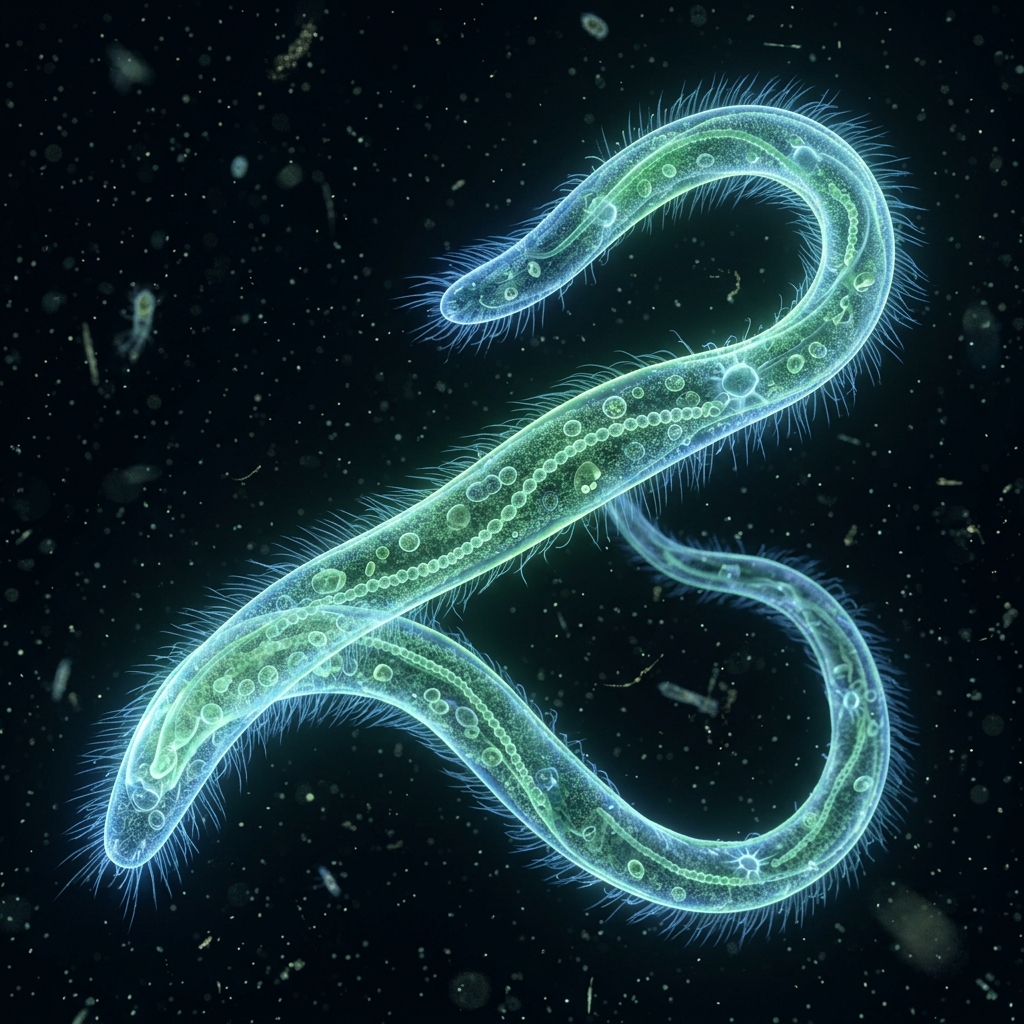
 Fig 1: Full view of a slender, transparent Spirostomum captured under a darkfield microscope (*Image is for illustrative purposes only)
[!NOTE] *All microorganism images used in this article are 3D CG concept illustrations.
“Spirostomum” is a large ciliate that is a hidden favorite among microscopy enthusiasts due to its impressive size and extremely agile movement. Even as a single-celled organism, it grows so large that it can be seen with the naked eye, appearing like a moving piece of thin thread.
Ecology and Key Feature: Ultra-fast Contraction
Spirostomum inhabits the bottom of freshwater bodies where fallen leaves accumulate and decay, as well as slow-flowing roadside ditches. Their most remarkable feature is their ultra-fast contraction: the moment they detect physical stimuli or sudden changes in light, they shrink their body to less than 1/3 of its original length in just 1/100 of a second (10 milliseconds). This is considered one of the fastest cell contraction movements in the animal kingdom, driven by a network of specialized protein fibers called “myonemes” running through the cell.
Tips for Collection and Observation
- Collection Location: Collect mud from the bottom of a pond rich in aquatic plants, or fallen leaves (such as oak or cherry leaves) submerged in puddles, along with the surrounding water in a bottle.
- Screening: Pour a thin layer of the collected muddy water into a Petri dish and illuminate it diagonally with a bright light. If you look closely, you will find very slender, thread-like organisms a few millimeters long swimming slowly in a winding or straight path.
- Microscopic Observation: Use a pipette to draw them out, place them on a slide glass, and observe. Because they are large, low magnification (40x to 100x) is ideal. When applying a cover glass, make sure to add some spacing (by placing small pieces of cover glass or spacers underneath) so the organism is not crushed, allowing you to observe it moving around energetically.
- Stimulation Experiment: While observing, try gently tapping the microscope stage with your finger to apply vibrations. You can witness the dynamic sight of the organism instantly contracting into a ball and slowly returning to its original slender shape over a few seconds.
As long as the water does not severely spoil, they can be maintained for several weeks by keeping a small amount of the original fallen leaves in the collection container. Try searching your local water sources for this amazing single-celled organism!