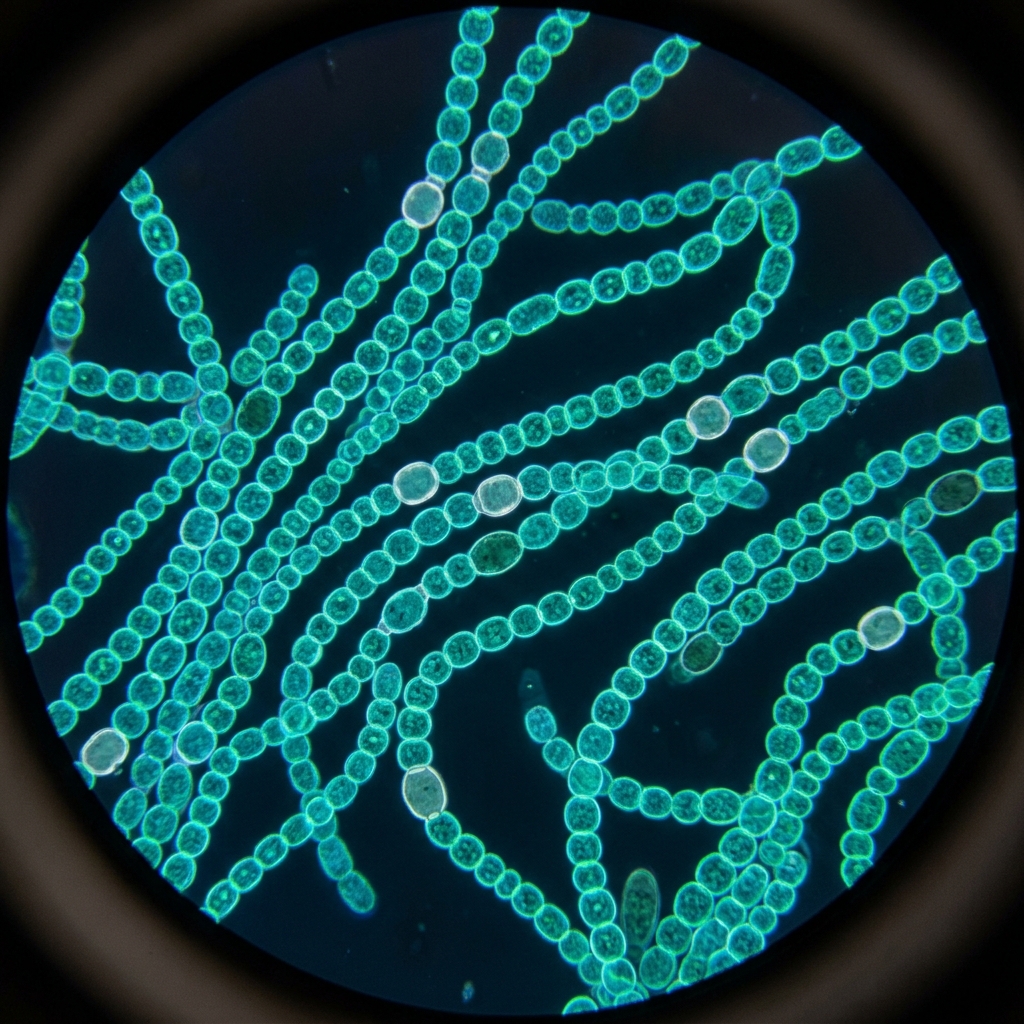
 Fig 1: Beautiful chain-like cyanobacteria (Nostoc sp.) captured under a darkfield microscope (*Image is for illustrative purposes only)
[!NOTE] *All microorganism images used in this article are 3D CG concept illustrations.
Quietly thriving right under our feet is a “living fossil” that dates back over 2.7 billion years in Earth’s history: Nostoc (Nostoc commune), a representative type of cyanobacteria (blue-green algae).
When dry, it looks like a piece of crispy black seaweed, but when it rains, it absorbs water and swells into a squishy green jelly-like substance. In this guide, we explain how to collect this highly accessible extremophile and observe its beauty under a microscope.
🎯 Quick Summary & FAQ (Conclusion First)
Q. Where can I collect Nostoc? A. They are scattered everywhere on sunny ground, such as in gravel roads, parks, home lawns, and asphalt cracks. On sunny days, they dry up and cling to the ground, but if you look after rain, they swell into green jelly, making them easy to pick up with tweezers.
Q. What magnification is needed for observation? A. A biological microscope at 100x to 400x is ideal. Nostoc forms filaments, which are chains of single cells linked like beads. At 100x, you can capture the overall structure resembling a beaded necklace, and by bumping it up to 400x, you can clearly observe the outlines of individual cells and the specialized “heterocysts” that perform nitrogen fixation.
🔬 1. Nostoc Collection and Slide Preparation
Nostoc does not require any special culturing medium to grow. You can use freshly collected wild specimens immediately, or hydrate dried, preserved samples to get high-quality observation specimens anytime.
Step-by-Step Slide Preparation
-
Collection Method: Using tweezers, collect the swollen green to dark brown-green gelatinous clumps from damp gravel paths or lawns after rain, and place them in a plastic case or Petri dish filled with water. *If you collect dry Nostoc, submerge it in a cup of water for about an hour, and it will restore to its original gel state (recovery from cryptobiosis).
-
Washing: Since it tends to have sand and soil particles clinging to it, gently rinse it in tap water to wash away the dirt.
-
Cutting and Mounting: Nostoc is encased in a thick polysaccharide gel sheath. Since it is too thick to transmit light directly, tear off an extremely tiny piece (less than 1/100 of a grain of rice) using a razor blade or the tip of tweezers, and place it on a slide glass.
-
The Squash Hack: Once the cover glass is in place, gently press straight down on it with your finger or a cotton swab to flatten and spread out the gel. This spreads the cell chains into a single layer rather than overlapping, making observation dramatically easier.
2. Observation Points: Beautiful Beaded Chains and “Heterocysts”
When you focus the microscope, mysterious spiral or wavy cell chains (trichomes) will appear across the field of view, looking like chains of beautiful emerald-green beads.
Three Cell Types to Look For
If you observe the Nostoc cell chains closely, you will see that they are not just identical cells linked together; they change their appearance depending on their functional roles.
| Cell Type | Key Features & Identification | Critical Role |
|---|---|---|
| Vegetative cell | Common round, green cells that make up most of the chain. | Performs photosynthesis to produce organic matter (sugars) from carbon dioxide. |
| Heterocyst | Slightly larger than vegetative cells, with a lighter color and thick walls. | Takes in atmospheric nitrogen and converts it to ammonia, which plants can utilize (nitrogen fixation). |
| Akinete | Rare large, oval cells with extremely thick outer walls found within the chains. | Survives harsh environments such as dehydration or extreme cold, acting like a seed to ensure survival. |
[!IMPORTANT] Tips for Observing Heterocysts The enzyme nitrogenase, which converts nitrogen to ammonia, is highly sensitive to oxygen, so the inside of the heterocyst must remain completely oxygen-free. Consequently, heterocysts are covered by thick glycolipid walls that block oxygen and do not perform photosynthesis (the process that produces oxygen). When observing under a microscope, if you spot a larger cell that is slightly paler than the surrounding cells and has a double-contoured capsule-like outline, you are looking at the site of nitrogen fixation.
3. Appreciating the Greatness of the Blue-Green Algae That Built Earth’s Environment
Cyanobacteria like Nostoc are monumental organisms that released massive amounts of oxygen into Earth’s primitive atmosphere for the first time, laying the foundation for today’s ozone layer and rich biodiversity. The reason they have survived for billions of years without changing their form is because they combine a perfect photosynthesis system (requiring only light to feed themselves) and nitrogen-fixing capabilities (creating nutrients from the air) at a single-cell level.
Why not take a peek under the microscope at those ordinary crispy black flakes lying around in your garden, park, or roadside, and experience a micro emerald necklace with a 2.7-billion-year history?
🔗 Related Articles
- 👉 Microscopic World: A Simple Guide to Collecting and Observing the Beautiful Single-Celled ‘Anabaena’ at Home
- 👉 Microscopic World: A Simple Guide to Collecting and Observing the Beautiful Single-Celled ‘Oscillatoria’ at Home
- 👉 The Microscopic Medal: A Guide to Collecting and Observing Pediastrum | Beautiful Green Algae Forming Geometric Star-shaped Colonies
- 👉 Beginner’s Guide: How to Choose a Home Microscope Without Regrets | Comparison of Recommended Models Supporting Smartphone Photography
- 👉 The Smartphone Microscopy Textbook: 3 Optical Axis Adjustment Hacks to Prevent Vignetting and Shoot High-Quality Images