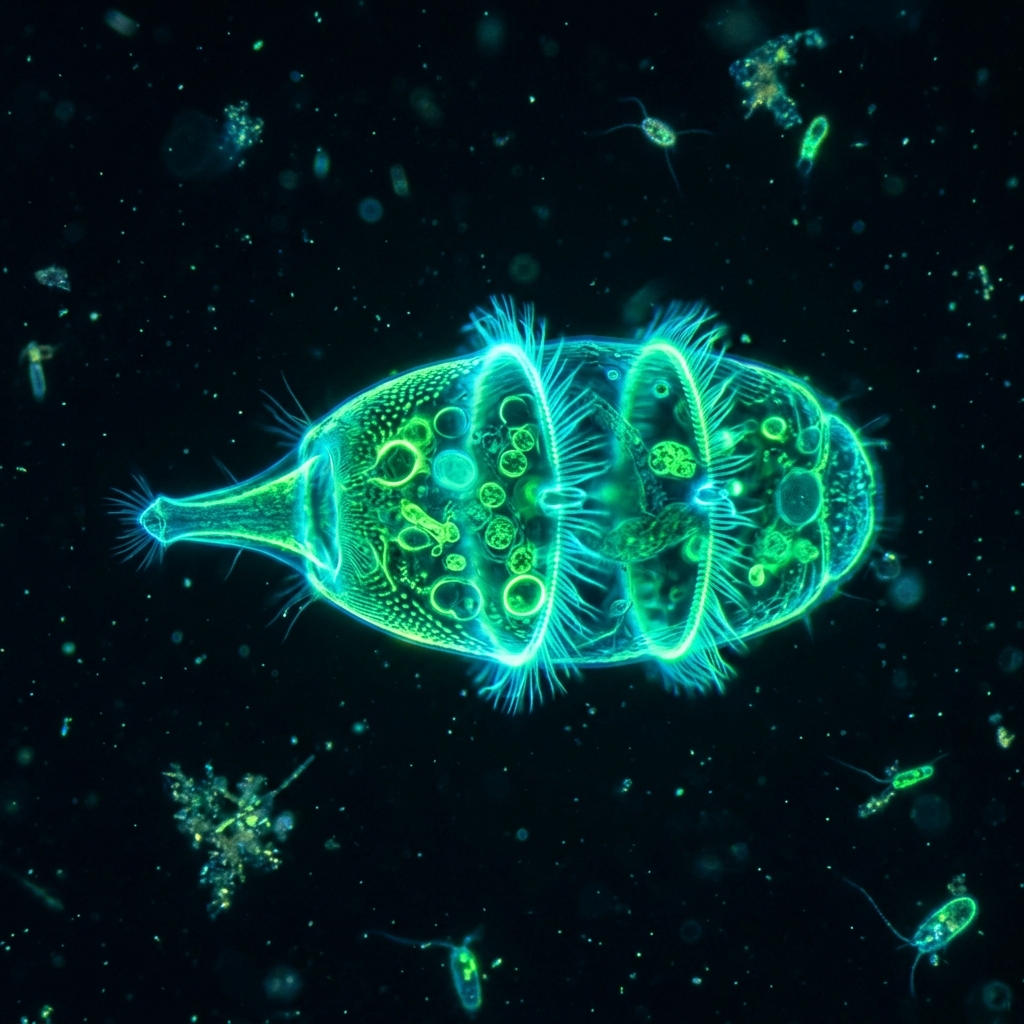
 Fig 1: A barrel-shaped Didinium with bands of cilia swimming actively (*Conceptual image).
[!NOTE] *All microorganism images used in this article are conceptual 3D CG renders.
🎯 Quick Summary & FAQ (Key Takeaways)
Before diving into the detailed guide, here are quick answers to the most common questions.
Q. How do I maintain a Didinium culture long-term?
A. Continuous supply of Paramecium prey and collecting/storing resting cysts are the keys.
Didinium feeds exclusively on Paramecium. If they run out of food, they will encyst into round spheres within hours. Keeping multiple bottles of Paramecium culture on standby is critical to maintaining active Didinium colonies.
Q. How can I make the predation events easier to observe?
A. Concentrate both organisms within a small drop on a concavity (well) slide.
In a wide dish or flat slide, the ciliates often swim past each other, taking a long time to collide. Confining them to a tiny droplet dramatically increases the encounter rate.
🔬 1. Biology and Predatory System of Didinium
Didinium nasutum offers some of the most dynamic predation scenes under the microscope. Swimming like a spinning top using two ciliary bands, its barrel-like body looks comical, yet it is a ferocious predator often dubbed the “lion of the micro-world.”
Paralyzing Prey Instantly with Toxicysts
At the anterior tip of the Didinium cell is a cone-shaped snout (proboscis). This structure is packed with microscopic harpoon-like organelles called toxicysts. Upon colliding with a Paramecium, the hunter fires these toxicysts instantly, paralyzing the prey.
Swallowing Large Prey Whole via a Stretchable Cytostome
Once the prey is paralyzed, Didinium attaches its snout to it. The snout expands into a highly elastic cytostome (cell mouth), swallowing the Paramecium whole—much like a snake swallowing an egg—in a matter of minutes. After feeding, the Didinium body swells and stretches into a bloated sphere.
2. Practical Steps for Culturing Didinium
To succeed in culturing Didinium, you must establish a “dual-culture system” to keep a constant supply of Paramecium feed.
Step 1: Concentrating Paramecium (Prey Prep)
If you pour raw Paramecium culture medium directly into the Didinium container, organic waste and residual yeast will contaminate it. This ruins the water quality, causing bacterial blooms and oxygen depletion.
- Place your Paramecium culture in a test tube and let it stand in the dark for a few hours. The ciliates will gather near the surface. You can also collect them into a clean layer of water using a cotton-plug migration method.
- Use a pipette to siphon off only the clean water densely packed with Paramecium and add it to the Didinium vessel.
Step 2: Subculturing & Cyst Management
Didinium are voracious eaters; a single cell can consume dozens of Paramecium per day. They divide rapidly when food is abundant but form hard-shelled resting cysts as soon as food runs out.
- Active Culture Maintenance: Add fresh concentrated Paramecium every 2 to 3 days.
- Long-Term Storage (Encystment): Allow the culture to sit without food for several days. Spherical cysts will settle on the bottom. These cysts can survive dryness and cold, permitting refrigerator storage for months or even over a year. Adding a fresh Paramecium suspension will wake them up within hours.
3. Troubleshooting Matrix
| Issue | Potential Cause | Action Plan & Hacks |
|---|---|---|
| Didinium disappear (only round grains remain) despite adding Paramecium | Food was depleted, triggering encystment | Collect the round cysts from the bottom. To reboot, prepare a new vessel with fresh dechlorinated water, add a dense population of Paramecium, and introduce the cysts. |
| Water smells foul and the population crashed | Residual yeast or organic debris from the Paramecium feed fouled the water, depleting oxygen | Always use concentrated and washed Paramecium for feed. If water quality drops, use a pipette to isolate healthy cells and transfer them to clean water. |
| Cells stop dividing and lose activity | Temperature is outside the optimal 20°C–25°C range (especially high summer temperatures) | During summer, place the container in an air-conditioned room or wine cellar to maintain ~22°C. Since they do not photosynthesize, they can be kept in the dark. |
4. Microscope Hacks: Capturing the Predation Moment
Watching Didinium hunt is highly exciting, but both ciliates swim so fast that maintaining focus is challenging without proper preparation.
The Cotton Fiber Hack
Tease out a few strands of cotton fiber onto your slide. Drop one drop of water containing both Didinium and Paramecium onto it, then gently apply a cover slip. The fibers form a microscopic jungle gym, limiting their swimming speed and keeping them in a narrow field of view. (Adding a drop of 1% methylcellulose solution to increase viscosity is also effective.)
Oblique Illumination (Pseudo-Darkfield) to Reveal Toxicysts
Shift the condenser slightly off-center or block half the light path to create oblique illumination. This highlights the fired toxicysts and ciliary bands as bright white lines, enabling you to shoot stunning, high-contrast 3D-like photos on your smartphone.
For details on high-quality smartphone microscopic photography and alignment, refer to these guides:
- Optical Alignment: The Smartphone Microscopy Guide: Three Optical Alignment Hacks to Prevent Vignetting
- Using Adapters: Essential Tools: Choosing and Aligning Smartphone Adapters for Microscopy
- Lighting Hacks: High-Brightness LED Ring Lights and DIY Lighting Secrets
🔗 Related Articles (Topic Cluster)
- 👉 Culturing & Observing Paramecium: Easy Breeding in Plastic Bottles with Rice Bran
- 👉 The Smartphone Microscopy Guide: Three Optical Alignment Hacks to Prevent Vignetting
- 👉 Essential Tools: Choosing and Aligning Smartphone Adapters for Microscopy
- 👉 High-Brightness LED Ring Lights and DIY Lighting Secrets