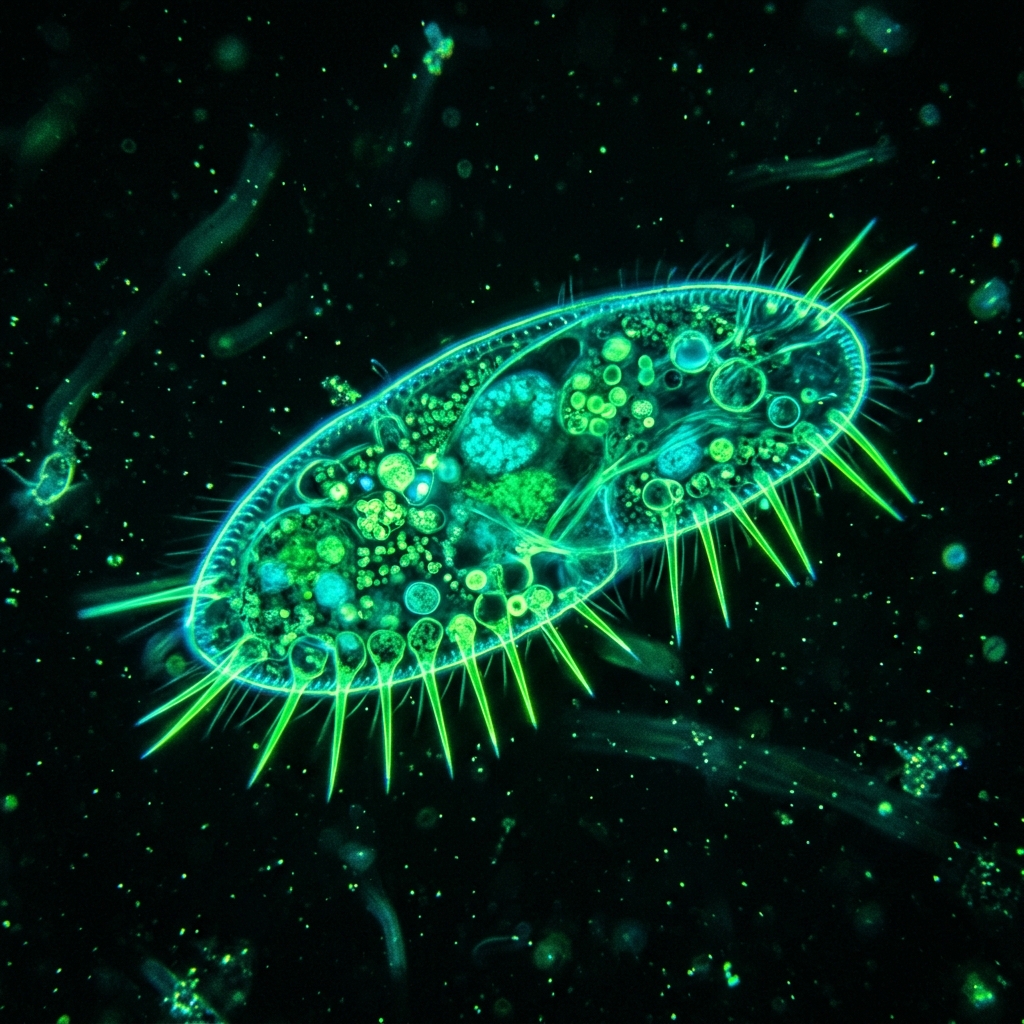
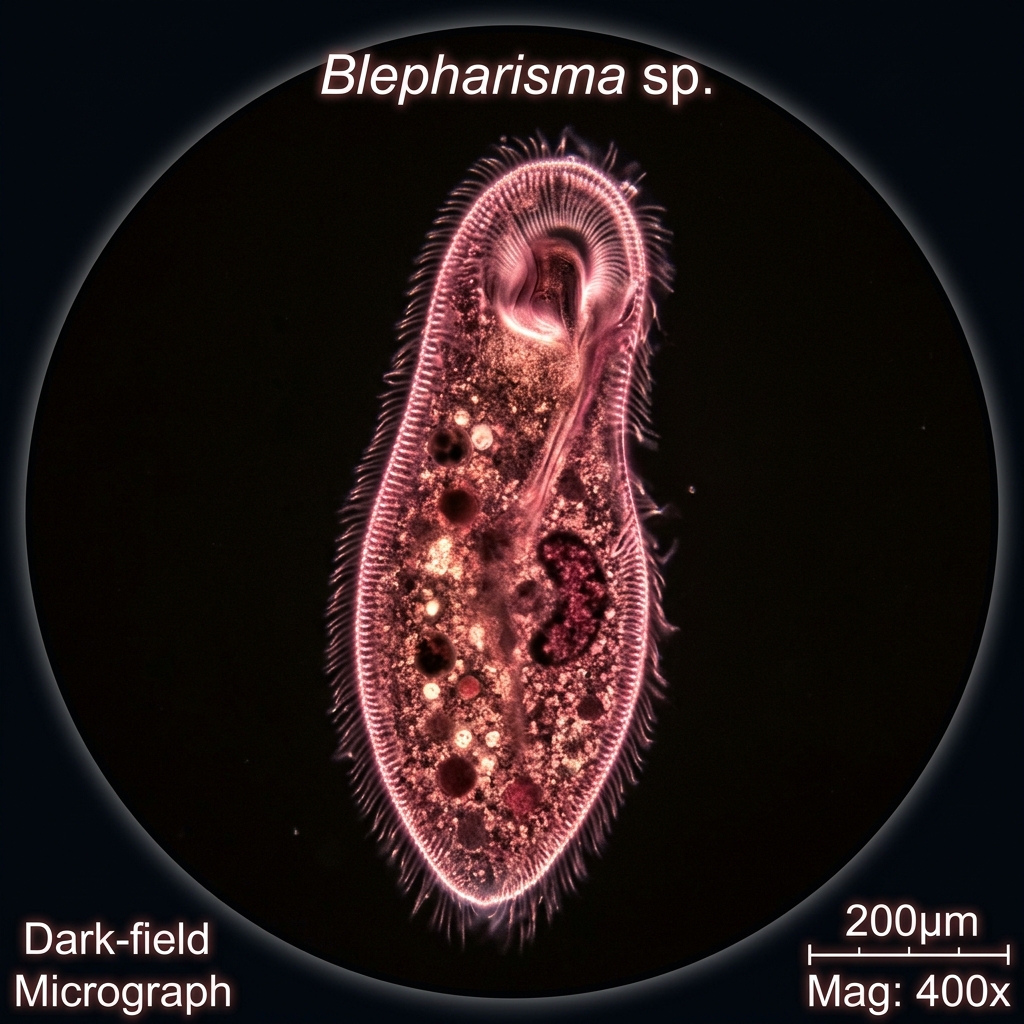
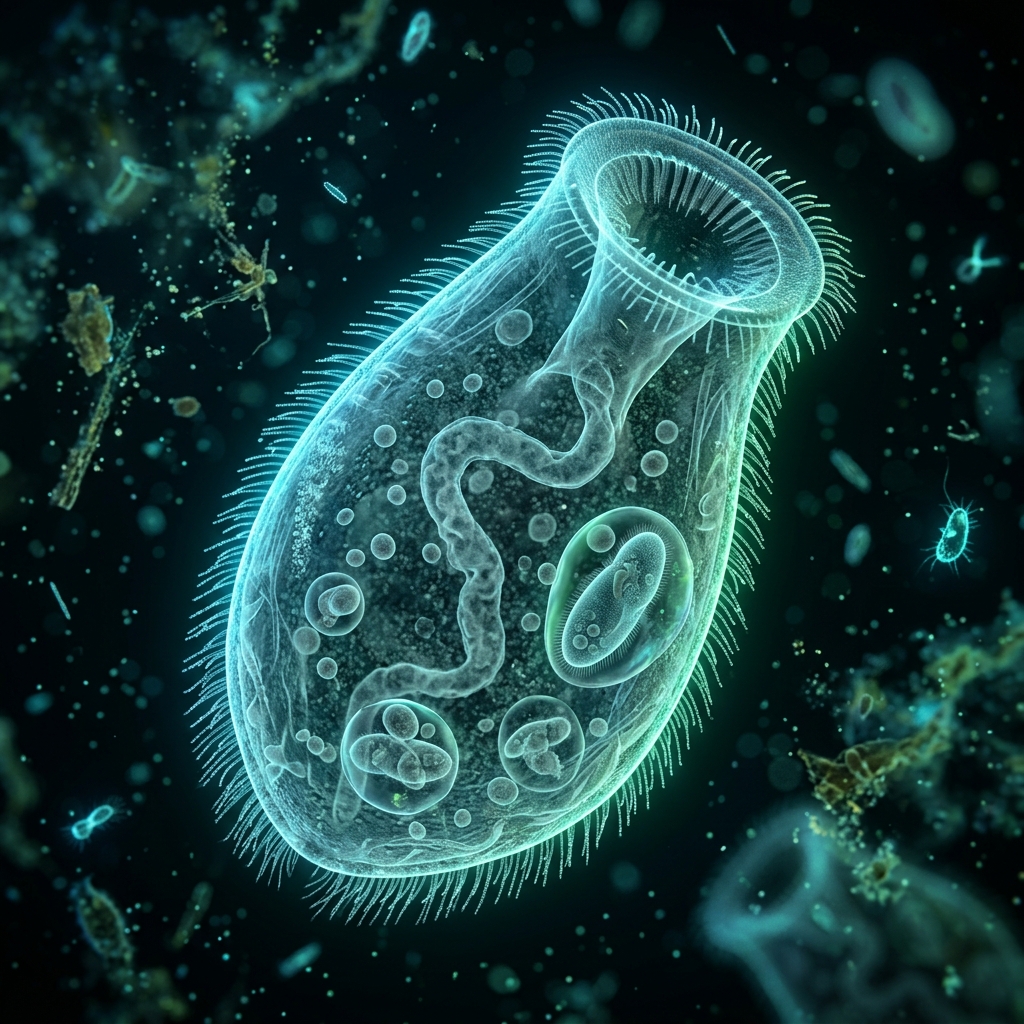
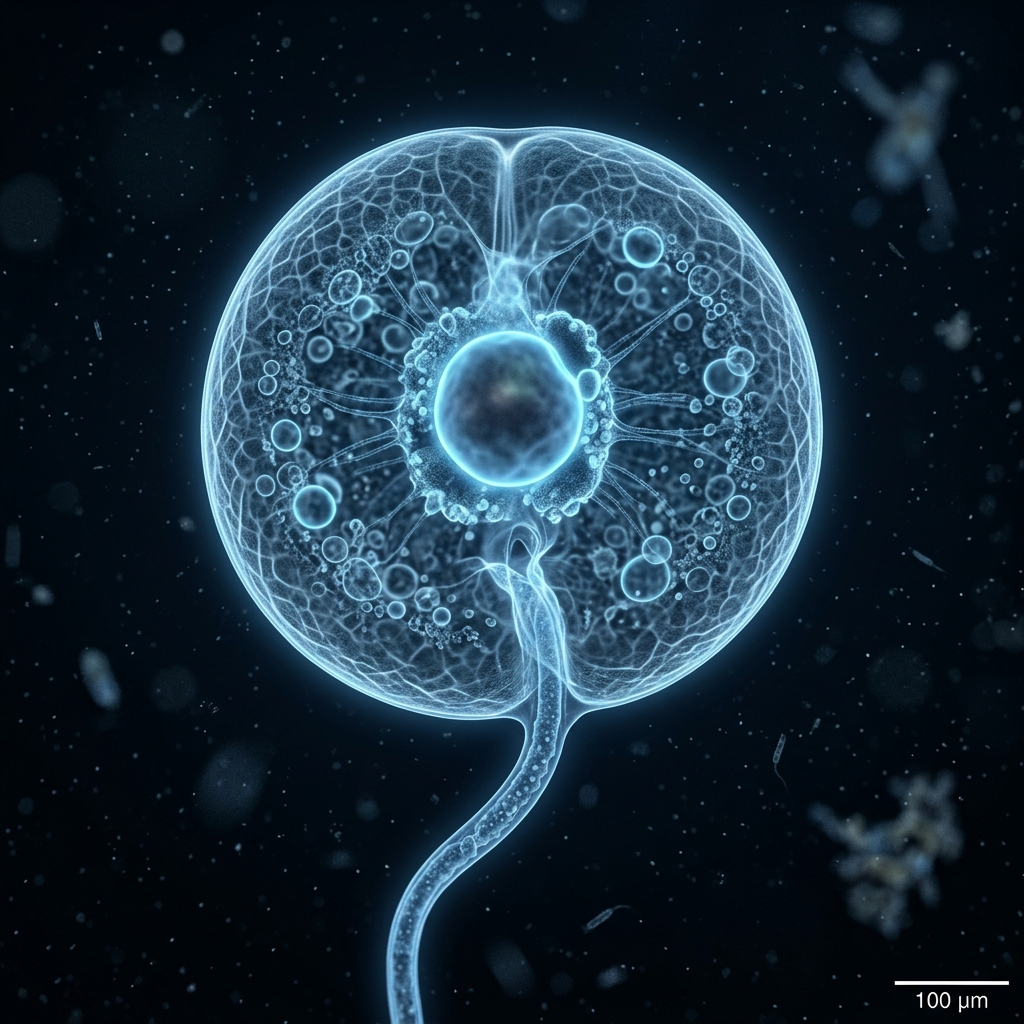
 Figure 1: Microscope image of Noctiluca scintillans emitting a mysterious blue bioluminescence from its cytoplasm upon receiving stimulation (*Image is for illustrative purposes only).
[!NOTE] *All microorganism images used in this article are 3D CG conceptual images.
🎯 Quick Summary & FAQ (Conclusion First)
Before going into the detailed explanation, here are answers to the most common questions.
Q. Can Noctiluca be reared in regular water (tap water or fresh water)? A. No, they cannot. Brackish to seawater (approx. 3% salinity) is absolutely required. Use dechlorinated tap water mixed with commercial artificial seawater mix for marine aquariums, adjusted to a specific gravity of around 1.020 to 1.024. In fresh water, their cells will instantly collapse and die due to osmotic pressure.
Q. Why does it not glow blue even when I stimulate it? A. It might be due to a lack of light (charging) during the day, or a disrupted day-night cycle. Although Noctiluca do not photosynthesize themselves, their food phytoplankton (Tetraselmis, etc.) need light to grow via photosynthesis. In addition, Noctiluca has its own internal circadian clock; they will only emit a strong glow when they are exposed to sufficient light during the day and then stimulated in a dark room at night. If kept in a dark place for 24 hours continuously, they will stop glowing.
🔬 1. Noctiluca Culture Medium (Seawater) Preparation and Introduction
Have you ever seen the magical sight of the shoreline or a boat’s wake glowing blue-white on a summer night? In many cases, the cause is the single-celled organism Noctiluca (scientific name: Noctiluca scintillans), which has a diameter of about 1 mm.
Noctiluca is a type of zooplankton and can be seen with the naked eye as tiny, transparent beads. Here is a guide on how to culture this “aurora of the sea” at home and enjoy its blue light every night.
Foolproof Seawater Prep and Temperature Management
Noctiluca are delicate marine organisms. Follow these steps to set up the optimal habitat:
- Prepare the Base Water: When using tap water, let it sit out in advance or use a commercial dechlorinating agent (sodium thiosulfate) to completely remove chlorine.
- Mix Artificial Seawater: Dissolve “artificial seawater mix” obtained from aquarium shops or online stores into the dechlorinated water according to the package instructions. The optimal salinity is around 3.0% to 3.3% (specific gravity 1.020 to 1.024).
- Keep the Temperature Cool: The optimal temperature for Noctiluca is 15°C to 22°C. They are very weak to summer indoor temperatures in Japan (above 25°C). If the water temperature rises, they will melt and die overnight. During summer, keep the temperature around 20°C using an air-conditioned room, a wine cellar, or a thermoelectric cooler.
2. Rearing Food (Tetraselmis) and Troubleshooting
Noctiluca do not photosynthesize like plants. To survive and multiply, they must be fed microalgae (primarily Tetraselmis or diatoms) regularly.
Rearing Troubleshooting Matrix
| Issue | Probable Cause | Action / Hack |
|---|---|---|
| Water is cloudy and smells like a ditch | Overfeeding of Tetraselmis led to eutrophication, causing an outbreak of bacteria. | Immediately use a dropper to siphon out surviving transparent Noctiluca and transfer them to freshly mixed, clean artificial seawater. |
| Transparent Noctiluca beads disappeared and settled at the bottom | Death due to high water temperature (above 25°C) or sudden change in water quality. | Move the container to a cool place (around 18°C) and rescue the surviving individuals into new seawater to avoid a total crash. |
| Vigorously shaking the container at night only produces a faint glow | The day-night cycle is disrupted (lack of contrast), or energy is depleted due to lack of food. | Expose the culture to 12 hours of light during the day on a bright windowsill (avoid direct sunlight to prevent overheating) or under a plant LED, and observe in a completely dark room at night. |
| Noctiluca cluster together at the water surface | Condition is excellent. Since Noctiluca are highly buoyant, healthy individuals naturally float to the surface. | No action needed. However, gently swirl the bottle periodically to introduce air and prevent an oil film from forming. |
[!TIP] Feeding Hack: Add the food Tetraselmis (green liquid) in small amounts, just enough to tint the culture water a very pale green. When the water becomes completely clear, it is a sign that Noctiluca has consumed all the food. Add a small amount of food again.
3. Microscope and Smartphone Hacks for Capturing the “Blue Glow”
The signature blue glow of Noctiluca occurs only for a fraction of a second when physical stimulation (shaking or water flow) is applied to its tentacle or cell body. A bit of ingenuity is needed to capture this moment in photos or videos.
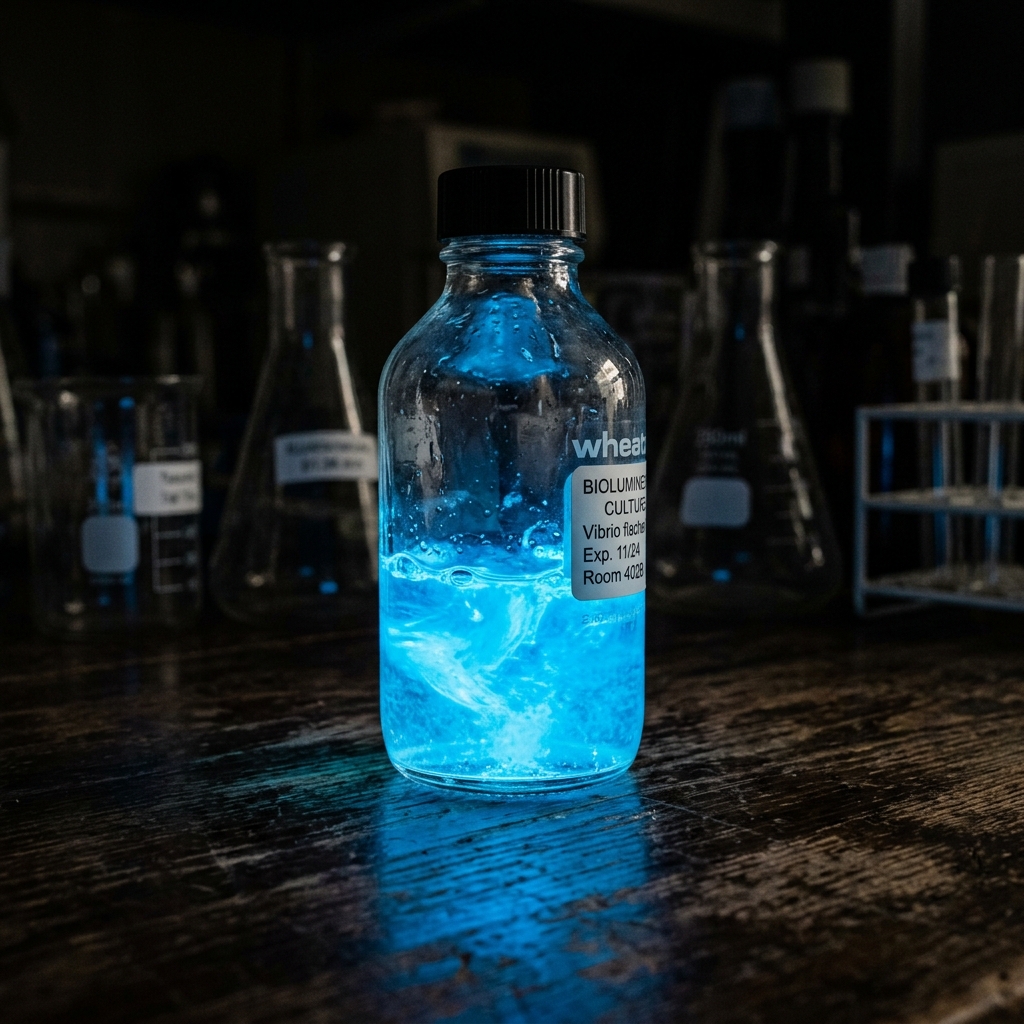 Figure 2: The Noctiluca reacting and emitting blue light simultaneously when the bottle is gently shaken in the dark (*Image is for illustrative purposes only).
Setting Hacks to Capture Magical Blue on Smartphones
In auto mode, Noctiluca’s glow is often too dark for the camera to focus on, or it gets buried under noise. Try these manual settings:
- For Shooting Videos:
- Set the smartphone’s camera app to “Pro” or manual exposure mode.
- Set the ISO sensitivity to “1600–3200” to maximize low-light sensitivity.
- Lower the frame rate to “30fps (or 24fps)” to secure the longest possible exposure time per frame.
- Drop water containing Noctiluca onto a slide glass or Petri dish using a dropper. While recording in the dark, gently tap the slide with a finger or blow on it to create water currents.
- For Microscope Photos:
Since Noctiluca are large, it is best to observe them at a low magnification of 10x to 40x. Use a dedicated adapter to keep the smartphone’s optical axis aligned.
- For the basics of optical axis alignment and preventing vignetting, see “Smartphone Microscope Photography Guide: 3 Optical Axis Adjustment Hacks to Prevent Vignetting and Get High-Quality Images”.
Noctiluca blinking blue like stars in response to physical agitation in the pitch-black field of view of a microscope. It is a premium experience that makes you feel like you are exploring the deep sea in your own room. Why not try culturing this mysterious “living light”?
🔗 Related Articles
- 👉 Darkfield & Polarization: DIY Lighting Hacks to Turn Microscope Photos into Art!
- 👉 Smartphone Microscope Photography Guide: 3 Optical Axis Alignment Hacks to Prevent Vignetting and Get High-Quality Images
- 👉 Micro Hunting: Plankton Sampling Nets and Easy Glass Petri Dish Culturing Sets
- 👉 Essential Microscope Photography Items: Smartphone Adapter Selection and Alignment Tips
- 👉 Jewels Under the Microscope: Silica Culture Water Recipe to Grow Beautiful Diatoms with Glass Shells