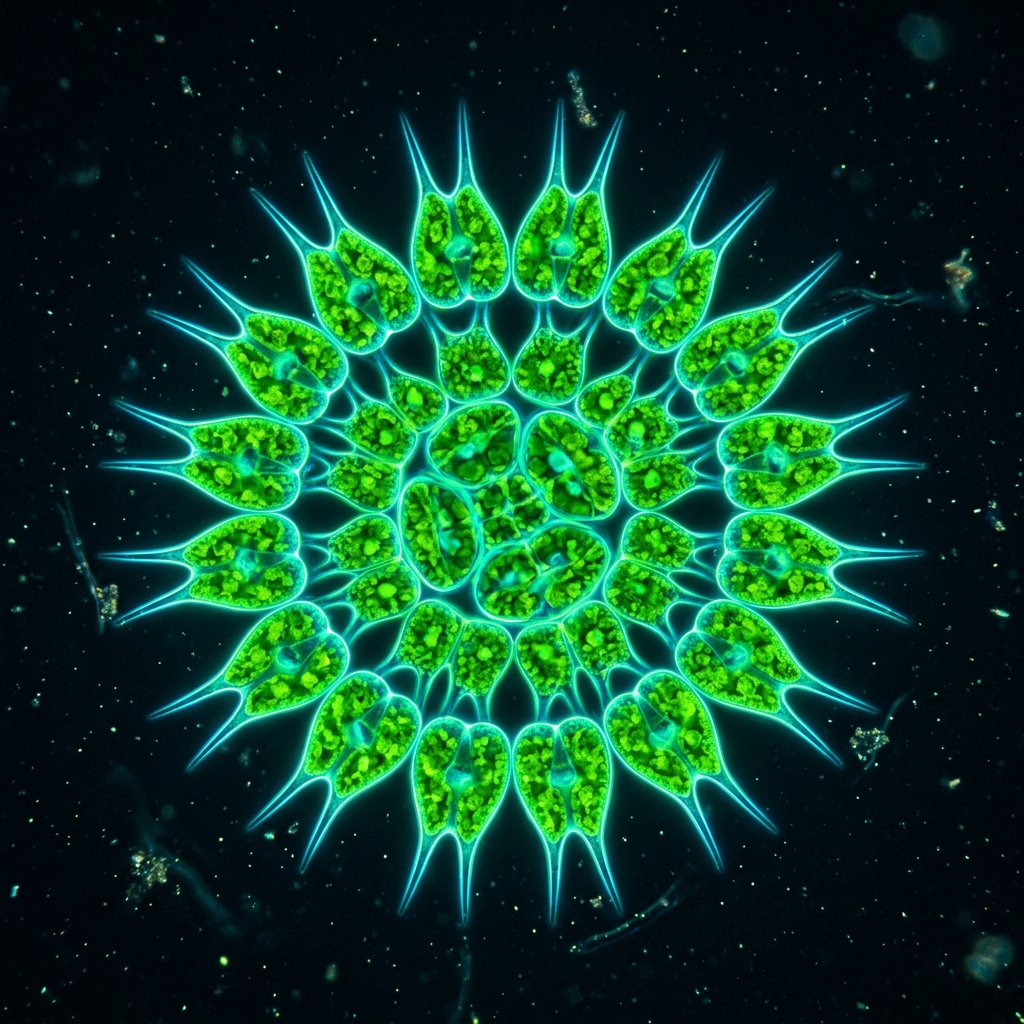
 Figure 1: Pediastrum forming a beautiful star-shaped/disc-like colony with geometrically arranged cells (*Image is for illustrative purposes only).
[!NOTE] *All microorganism images used in this article are 3D CG conceptual images.
🎯 Quick Summary & FAQ (Conclusion First)
Before going into the detailed explanation, here are quick answers to the most common questions about Pediastrum.
Q. What kind of organism is Pediastrum? A. It is a freshwater green alga where multiple cells dock flatly to form a beautiful symmetrical pattern resembling a gear, star, or “medal” (hence its Japanese name “Kunshou-mo,” meaning medal alga). Single-celled organisms gather to form a colony according to specific rules (coenobium). The beauty of discovering its perfect geometric form under a microscope is extraordinary.
Q. Where can I collect it? A. You can find them in sunny, established ponds, park ponds, and rice paddies (especially in summer when the water is stable), by scooping water from shallow areas where aquatic plants like duckweed or water hyacinth grow. The trick is to use a dropper to gently siphon water around the roots and leaves of water plants, collecting it along with mud and debris.
Q. Can I grow it at home? A. Yes, you can. Since they photosynthesize like Closterium, you can easily maintain and propagate them long-term using dechlorinated water with a tiny amount of liquid gardening fertilizer (such as Hyponex) under a bright LED light.
🔬 1. The Geometry of Pediastrum: Mystery of the Coenobium
Pediastrum (scientific name) is loved by plankton observation enthusiasts as one of the most visually striking algae. The reason lies in the precise geometric patterns created by nature.
A Colony with a Fixed Number of Cells: “Coenobium”
Pediastrum cells do not simply cluster at random.
- Coenobium: The number of cells making up the colony is predetermined from the start, and the number of cells does not increase during growth. Typically, a power of 2, such as 4, 8, 16, 32, or 64 cells, binds flatly without gaps to form a disc-like colony.
- Division of Labor in Inner and Outer Design: The cells at the center of the colony are polygonal and fit tightly without gaps, whereas the cells on the outer perimeter extend two sharp “horns” outward. This is the main feature that makes it look like a gear or a medal.
Decorative Cell Walls
When magnifying to 400x or more under a microscope, you can observe very fine mesh patterns or tiny wart-like projections containing silica (silicon dioxide) on the surface of the cells (cell walls). Due to this robust structure, Pediastrum is less prone to predation compared to other soft plankton and has high tolerance to environmental changes such as drying.
| Feature | Pediastrum | Scenedesmus | Volvox |
|---|---|---|---|
| Colony Shape | Flat star-shaped or disc-like | Raft-like in a single row | Three-dimensional hollow sphere |
| Cell Arrangement | Concentric, coenobium | Parallel arrangement, coenobium | Spherical arrangement, coenobium |
| Cell Number | Primarily 8, 16, 32, 64 cells | Primarily 4 or 8 cells | Thousands to tens of thousands |
| Motility | None (simply floats in water) | None (simply floats in water) | Yes (rotates using numerous flagella) |
2. Foolproof Collection and Home Culturing Methods for Pediastrum
Like Closterium and Volvox, Pediastrum is an autotrophic organism that produces its own nutrients through photosynthesis. You must never feed them organic substances (such as kitchen waste, sugar, or rice bran) because it will cause explosive growth of bacteria and mold, suffocating and killing the Pediastrum.
📦 Tools to Prepare
- Wild water containing Pediastrum (or purchased starter culture)
- Dechlorinated tap water (left out for 24+ hours to dissipate chlorine)
- Hyponex Liquid Concentrate (general-purpose gardening liquid fertilizer)
- Plant growth LED light (or a bright windowsill out of direct sunlight)
- Glass Petri dish or transparent plastic container
- Fine-tip dropper
🌿 How to Make a “Homemade Microalgae Medium” (10,000x Dilution of Hyponex)
This is the easiest and most reliable recipe for propagating Pediastrum healthily at home.
Step 1: Base Water Preparation
Pour 1 liter (1,000ml) of dechlorinated water into a clean container.
Step 2: Add Hyponex Liquid Concentrate
Add just 2 drops (approx. 0.1ml) of Hyponex concentrate using a dropper and mix well (approx. 10,000x dilution).
[!IMPORTANT] If you add too much fertilizer thinking it will make them grow faster, other microalgae (water blooms) or filamentous algae like Spirogyra will explode, outcompeting the Pediastrum. Always maintain a “highly diluted” state.
Step 3: Inoculate and Place
Use a dropper to draw Pediastrum from the collected water under the microscope and transfer them to the Petri dish or jar containing the homemade culture water. Do not seal the container cap completely; cover it loosely to allow carbon dioxide from the air to dissolve. Place the container about 15 to 20 cm away from the plant growth LED light and illuminate it for about 10 to 12 hours a day.
🧬 3. Mystery of Asexual Reproduction: Self-Assembly of Zoospores
The process by which Pediastrum forms a new colony is one of the most exciting and mysterious biological phenomena visible under a microscope.
”Self-Assembly” Determining the Order of Arrangement
During asexual reproduction, the cytoplasm within a Pediastrum cell divides, forming numerous swimming cells with two flagella (zoospores) equal in number to the parent cell’s cell count.
- Release of the vesicle: The parent cell wall opens, and zoospores slide out, wrapped in a transparent thin bag (vesicle).
- Chaotic Swimming: The released zoospores swim around wildly and randomly inside the vesicle, as if they have their own will.
- Autonomous Formation (Self-Assembly): Suddenly, the zoospores stop moving simultaneously and begin to align flatly inside the vesicle. They adjust their positions relative to each other, with the outer cells forming horns. In less than a few minutes, they complete a geometric “star/gear” formation identical to their parent.
- Cell Wall Formation: They lose their flagella, adhere to each other, and form hard cell walls, giving birth to a new, small colony of Pediastrum.
The mechanism of self-assembly, where cells organize themselves into a medal shape without a brain or central coordinator, is studied in developmental biology and biotechnology.
graph TD
    A[Maturation of Parent Cell] --> B[Zoospores Formed Inside]
    B --> C[Released Enclosed in a Transparent Vesicle]
    C --> D[Zoospores Swim Vigorously Inside Vesicle]
    D --> E[Simultaneously Stop and Align Flatly]
    E --> F[Cells Adhere to Form a Geometric Colony]
    F --> G[Birth of a New Pediastrum Colony]
4. Microscope Observation Hacks and DIY Lighting
Because of its flat nature, Pediastrum is very easy to observe, but adding a little twist to the lighting can capture stunning glass-like details.
1. Perfect Focus: Direct Observation Without Spacers
When observing three-dimensional microorganisms like Paramecium or Amoeba, spacers are needed to prevent them from being crushed by the cover slip. However, Pediastrum is almost completely flat.
- Technique: Place a drop of water on the slide glass and apply the cover slip directly. Since the water layer becomes very thin, all Pediastrum cells are fixed on the same plane, allowing you to take beautiful photos with perfect focus across the entire field of view.
2. Oblique Lighting to Highlight Horns
The transparent horns at the tips of Pediastrum are prone to being washed out and difficult to see under normal brightfield (light from the front).
- Hack Method: Partially block the lower half of the microscope’s light source (or condenser) with a finger or opaque paper, directing light only from an angle below (oblique illumination).
- Effect: The cell outlines, surface grid patterns, and transparent horns stand out with sharp shadows like three-dimensional carvings, providing excellent depth.
🔗 Related Articles
- 👉 The Mysterious Crescent: Closterium Culturing and Microscope Observation Guide | Crystals Dancing in Brownian Motion and the Riddle of Conjugation Spores
- 👉 The Green Spaceship: How to Culture Volvox and Key Points for Observing Asexual Reproduction | How to Make Homemade Culture Water
- 👉 Darkfield & Polarization: DIY Lighting Hacks to Turn Microscope Photos into Art!
- 👉 The Shape-Shifting Monster: A Step-by-Step Guide to Safely Rearing Amoeba Long-Term Using a Home Rice Grain Medium