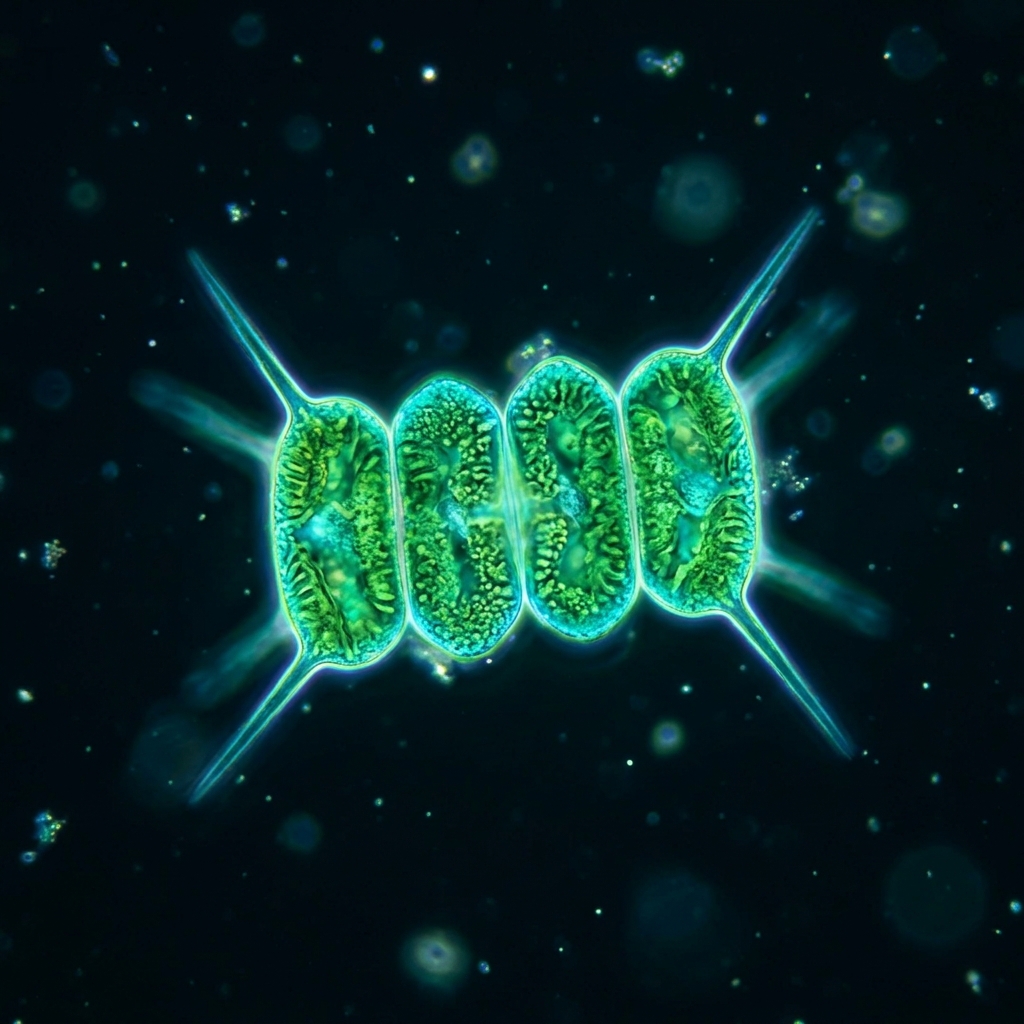
 Figure 1: A colony of Scenedesmus with four spindle-shaped cells arranged in a regular row, extending beautiful spines from both ends (*Image is for illustrative purposes only)
[!NOTE] *All microorganism images used in this article are 3D CG illustrations.
🎯 Quick Summary & FAQ (Key Takeaways)
Before diving into the detailed guide, here are quick answers to some common questions about observing and growing Scenedesmus.
Q. What kind of organism is Scenedesmus? A. It is a freshwater single-celled green alga (colony) in which typically 4 (sometimes 2 or 8) cells dock in a row, forming a shape like a raft. Characterized by the long “spines” extending from the outer corners of its cells, it is a well-known plankton in science textbooks due to its unique shape and ease of observation under a microscope.
Q. Where can I find and collect them? A. They are widely distributed in common freshwater environments such as sunny rice paddies, old puddles, planter saucers, and park ponds. In particular, using a dropper to collect slightly greenish water from rice paddies in summer gives you a high chance of finding them.
Q. Can I culture and propagate them at home? A. Absolutely. Because they photosynthesize, all you need is a tiny amount of liquid plant fertilizer (like HYPONeX) and a bright LED light to grow them explosively on a desk or window sill. Additionally, you can conduct a fascinating experiment at home by combining them with their natural predator, Daphnia, to observe how they change their body shape.
🔬 1. Basic Characteristics of Scenedesmus and the Mystery of “Phenotypic Plasticity”
When observed under a microscope, Scenedesmus (Scenedesmus) boasts such an artificial and neat design that you might wonder if it really evolved naturally.
The Raft-like Form and the Role of Spines
A Scenedesmus colony is a “coenobium” (a colony with a fixed number of cells) where the cells are born attached to each other during division, rather than individual cells aggregating later.
- Cell Arrangement: Typically, 4 cells (sometimes 2 or 8 depending on the environment) line up tightly in a row.
- Long Spines: Fine, sharp spines extend outward from the corners of the outermost cells. These spines act as “floats” to slow their settling rate in the water column so they can stay in the sunlit surface layer, and as a “defense” to prevent them from being swallowed whole by other tiny predators.
”Phenotypic Plasticity”: Morphing to Defend Against Predators
One of the most exciting biological aspects of Scenedesmus is phenotypic plasticity—the ability to change its morphology upon sensing the presence of predators.
When Scenedesmus is cultured long-term in clean media free of predators, its spines gradually degenerate, and it begins to grow as “spineless single cells” instead of forming 4-cell rafts. However, if you add water in which Daphnia (predators) have lived (which contains chemicals called kairomones, from Daphnia excretions), Scenedesmus morphs into a magnificent “4-to-8-cell raft colony” with sharp spines within just a few generations (1 to 2 days).
| Rearing Environment | Scenedesmus Morphology | Biological Intent |
|---|---|---|
| No natural predators (Clean water) | Mostly spineless single cells | Saves energy that would be wasted on building spines and colonies, prioritizing division rate. |
| Daphnia water (Kairomones present) | 4- to 8-cell raft colonies with long spines | Increases size and deploys spines to make it harder to enter the mouth (filter-feeding apparatus) of Daphnia. |
🧪 2. Reliable Scenedesmus Collection and Home Culturing Methods
Scenedesmus is remarkably tough compared to other algae and handles environmental changes well. With the following steps, you can easily maintain it at home as part of your micro-collection.
📦 Materials Needed
- Wild water containing Scenedesmus (or a starter culture)
- Dechlorinated tap water (left out for 24 hours)
- HYPONeX liquid fertilizer concentrate (liquid plant food)
- LED grow light for plants (or a bright windowsill)
- Clear plastic bottle or glass jar (approx. 500 ml)
🌿 Prep Steps for “Scenedesmus Culture Water” (10,000x Dilution of HYPONeX)
Just like other microalgae (Chlorella or Closterium), over-fertilizing is strictly prohibited. Excess nutrients cause bacterial blooms, which can wipe out the culture.
- Prepare the Base Water: Add 500 ml of dechlorinated water to a plastic bottle.
- Add Fertilizer: Add just 1 drop (approx. 0.05 ml) of HYPONeX concentrate. This creates a roughly 10,000-fold dilution.
- Introduce the Starter: Collect water containing Scenedesmus with a dropper, filter out large debris, and add it to the bottle.
- Lighting & Air: Keep the bottle cap slightly loose to let air pass through, and place it under an LED light (12 hours of exposure per day). Keep the water temperature between 20°C and 26°C for optimal growth.
After a few days to a week, the water will turn a faint light green. This is a sign that Scenedesmus is growing happily.
🧬 3. Microscope Observation Points and the Birth of “Autocolonies”
Each cell of Scenedesmus is quite small, measuring only 5 μm to 15 μm in length, which is much smaller than Pediastrum or Closterium. Therefore, you need higher magnification and careful focusing to observe them.
1. High-Magnification Focusing at 200x–600x
At 100x, they look like tiny green dots. Increase the magnification to 400x–600x, and close the condenser aperture slightly to enhance contrast. Observe the fine details of the transparent spines extending cleanly from the outermost cells.
2. Asexual Reproduction: A “Miniature Raft” Completed Inside the Parent
Scenedesmus’s asexual reproduction is highly efficient. The protoplast divides inside the parent cell, assembling a “miniature quadruplet raft” (called an autocolony) right inside the parent. Once ready, the parent’s cell wall splits longitudinally, and the fully formed mini-raft slides out. Capturing this moment—like a raft launching from a capsule—is a highlight of microscope observation.
graph TD
    A["Adult Scenedesmus colony"] --> B["Protoplast divides inside each cell"]
    B --> C["4 small autocolony cells line up inside the parent"]
    C --> D["Parent cell wall splits open longitudinally"]
    D --> E["Fully formed mini-raft slides out"]
    E --> F["Grows rapidly to original size"]
🧪 4. 【DIY Experiment】Triggering the Scenedesmus “Morph”!
Here are the steps for a fascinating Scenedesmus morphing experiment, perfect for science projects or hobbyist exploration.
- Group A (Control): Grow Scenedesmus in standard culture water.
- Group B (Experimental): Mix the culture water with about 20% of “Daphnia water” (water in which Daphnia were raised for 2 to 3 days, rich in their waste and metabolites) filtered through a fine filter to remove any actual Daphnia.
- Comparing Results: After 3 to 5 days, take a drop of water from each group and count the morphology of 100 random Scenedesmus under the microscope. Compare the proportion of “single cells” versus “4-to-8-cell colonies” and sketch how the spine lengths change.
Controlling the micro-environment yourself and watching these tiny organisms physically morph into defense mode is a truly exciting experience!
🔗 Related Articles
- 👉 [The Microscopic Medal] Pediastrum Culturing & Observation Guide | Beautiful Green Algae Forming Geometric Star-shaped Colonies
- 👉 [The Mystic Crescent] Closterium Culturing & Microscope Observation Guide | Crystals Dancing in Brownian Motion and the Mystery of Zygospores
- 👉 [The Green Spaceship] Volvox Breeding & Asexual Reproduction Guide | How to Make DIY Culture Water
- 👉 Propagating Daphnia at Home! Easy Breeding Manual Using Yeast and Green Water
- 👉 [Darkfield & Polarization] Dramatic Changes with Cheap DIY Materials! DIY Lighting Hacks to Turn Microscope Photos into Art
![[Microscopic Photography] Master Pseudo-Koehler Illumination Adjustment: The Ultimate Hack to Beautifully Record Microscopic Details](/images/tool_ring_light.png)
![[Microscopic Photography] Master Stage Micrometer Calibration: The Ultimate Hack to Beautifully Record Microscopic Details](/images/microscope_clamp.png)