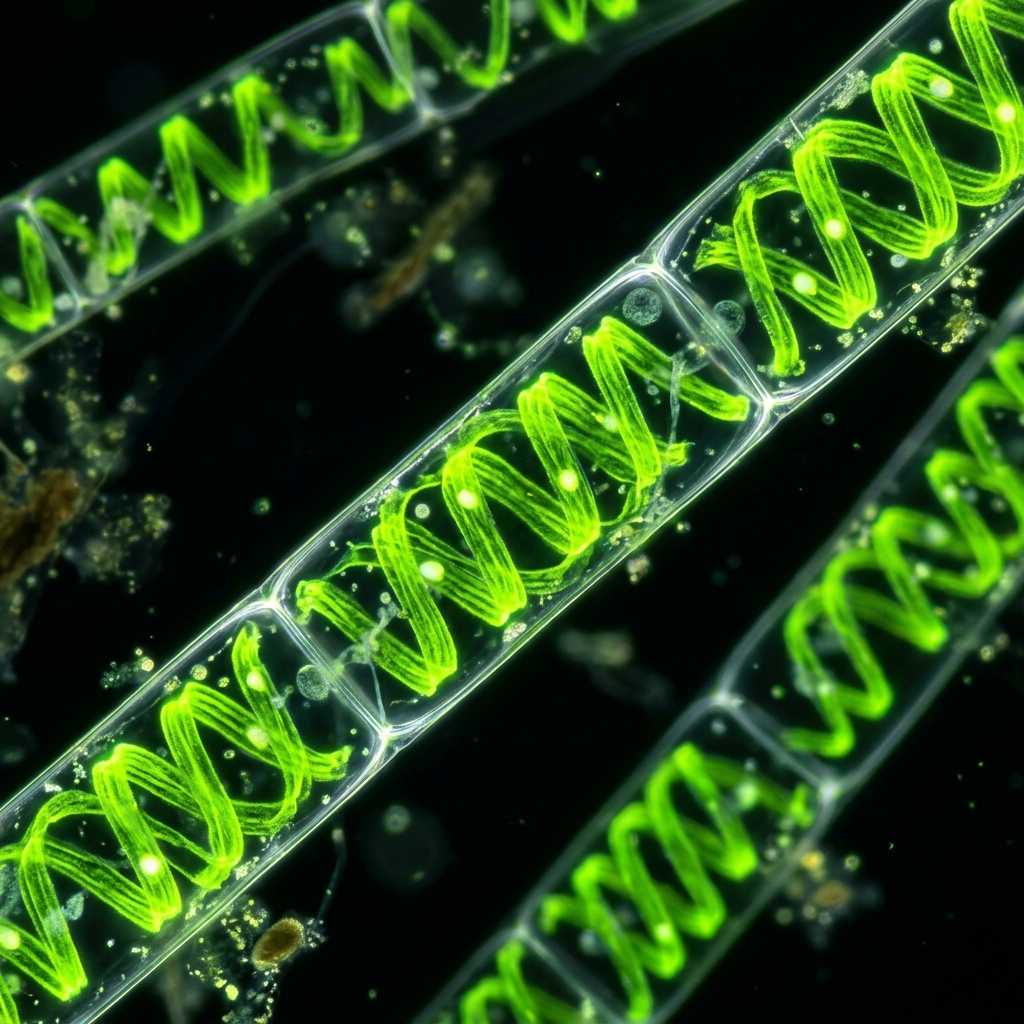
 Figure 1: Detailed structure of Spirogyra with ribbon-like chloroplasts wound beautifully like a spiral staircase inside each cell (*Image is for illustrative purposes only)
[!NOTE] *All microorganism images used in this article are 3D CG illustrations.
In the world of aquariums and pond maintenance, Spirogyra (commonly known as “pond scum” or “water silk”), which grows in slimy mats tangled around tank glass and aquatic plants, is notorious as one of the most hated weeds.
However, the moment you pull out a single filament of Spirogyra with tweezers, place it under a microscope (100x–200x), and pass light through it, its bad reputation is completely overturned. What appears is a breathtakingly intelligent and beautiful micro-geometric world, where brilliant emerald green ribbons are wound in regular patterns inside transparent glass cylinders, looking like beautiful spiral staircases. In this article, we explain the rearing techniques to keep this Spirogyra clean and clear without letting it decay into mush, and the hacks to observe their strange sexual reproduction behavior called “conjugation.”
1. Nutrient and Light Control to Make Spirogyra Shine Beautifully
When Spirogyra outbreaks occur in aquariums, the water is saturated with excess nutrients (nitrogen and phosphorus) dissolved from fish waste and leftover food. However, if you try to raise Spirogyra in a bottle under these conditions, the water will quickly become eutrophic, bacteria will bloom, and the Spirogyra itself will turn brown, rot, and emit a foul odor.
Surprisingly, the secret to keeping Spirogyra healthy and in its beautiful emerald-green state for a long time is to rear it under extreme, bare-minimum nutrient levels.
- Culture Water: Dechlorinated tap water or neutral soft mineral water containing no extra organic matter is best.
- Nutrient Source: Horticultural or aquatic plant fertilizer should be added in extremely minuscule amounts (less than one drop per liter). Adding more will rot the water.
- Light Intensity (Most Crucial): Spirogyra is the embodiment of photosynthesis. Place your glass container in a very bright spot where it can receive direct sunlight by a window for a few hours. With sufficient light, Spirogyra will release countless oxygen bubbles from its photosynthesis, floating beautifully on the water surface like a green curtain.
2. A Once-in-a-Lifetime Mystical Event: Observing Spirogyra Conjugation
The most spectacular phenomenon in the life of Spirogyra is “conjugation,” a sexual reproduction process triggered by seasonal transitions or environmental stress. While they normally grow longer by cell division along the filament (asexual reproduction), when the water begins to dry out or temperatures drop, two adjacent filaments line up like a ladder, extending tubes from their cells to merge.
Once conjugation begins, the contents of one cell (protoplast) pass completely through the conjugation tube into the adjacent cell, fusing to form a thick-walled “zygospore.” This process is a mystical sight, often referred to as a “bridge of love” in the micro-world.
[!TIP] “Dry Stress Hack” to Artificially Trigger Conjugation Allow the water in a petri dish containing plenty of Spirogyra to evaporate slowly over a few days without replenishing it. When the water depth drops to just a few millimeters and the Spirogyra is put in a pinch, observing it under a microscope will yield a high chance of seeing adjacent filaments extending conjugation tubes and forming zygospores, creating a dynamic ladder-like structure.
3. Enhancing Spirogyra Photos under the Microscope: “Backlight & Polarization”
The appearance of the spiral chloroplasts inside Spirogyra cells changes dramatically depending on how you focus the microscope. When making a slide, carefully pick out only 1 or 2 filaments with tweezers so they do not overlap, and cover them with a cover slip.
Focusing on the cell’s surface brings the spiral ribbons into sharp view. If you focus deeper into the center of the cell, you can observe the transparent cytoplasmic strands radiating like a spiderweb from the central nucleus.
From an annoying weed to an art piece inside a micro glass cylinder—why not quiet down and admire the beauty of these green spirals in a small glass jar on your windowsill?
![[The Green Spaceship] Volvox Breeding & Asexual Reproduction Guide | How to Make DIY Culture Water](/images/volvox_structure.png)
![[The Mystery of the Spring] Step-by-Step Guide to Collecting and Culturing Vorticella (Bell Animalcule) with Ultra-fast Contraction at Home](/images/vorticella.png)