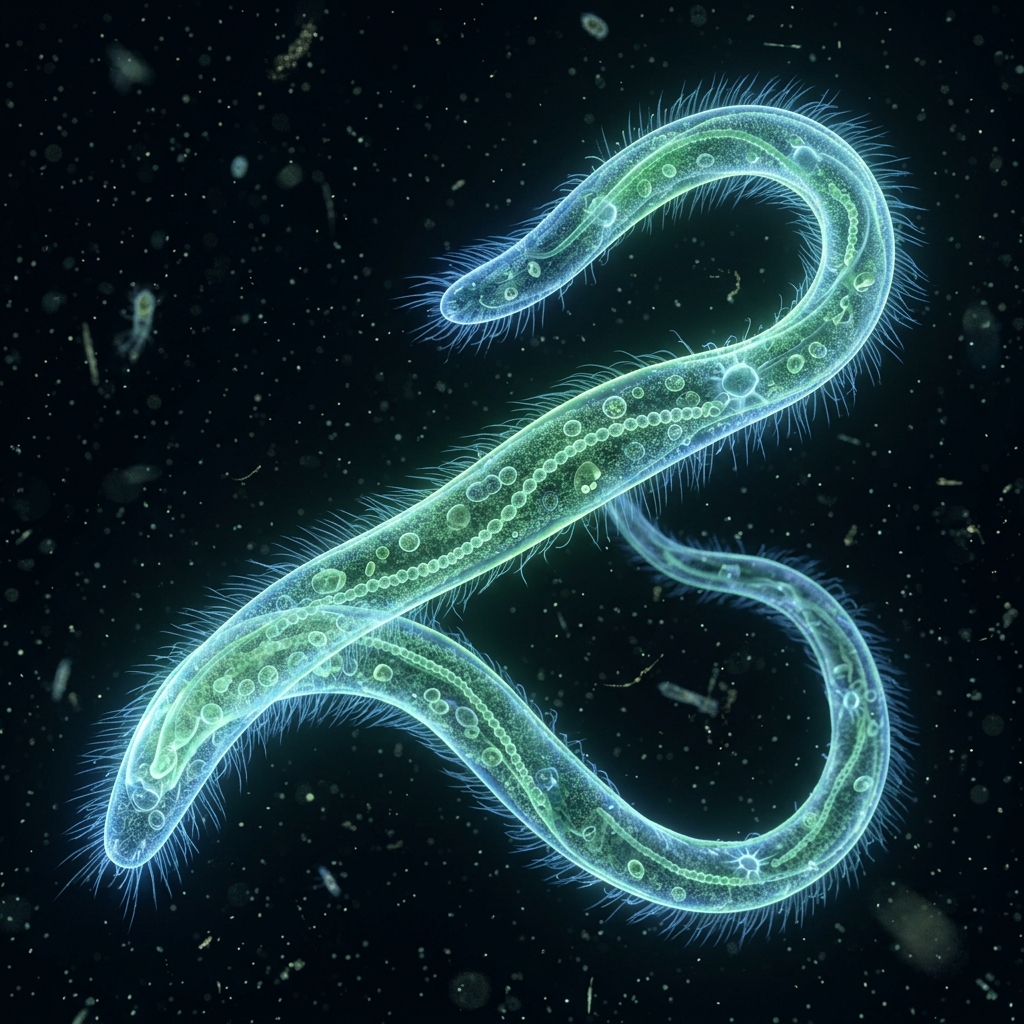
![[The Mystery of the Spring] Step-by-Step Guide to Collecting and Culturing Vorticella (Bell Animalcule) with Ultra-fast Contraction at Home](/images/vorticella.png) Figure 1: Vorticella anchoring its stalk firmly to the cell wall of an aquatic plant, creating water currents to feed on bacteria (*Image is for illustrative purposes only)
Figure 1: Vorticella anchoring its stalk firmly to the cell wall of an aquatic plant, creating water currents to feed on bacteria (*Image is for illustrative purposes only)
[!NOTE] *All microorganism images used in this article are 3D CG illustrations.
🎯 Quick Summary & FAQ (Key Takeaways)
Before diving into the detailed guide, here are quick answers to the most common questions.
Q. Where can you find Vorticella? A. They inhabit the surfaces of aquatic plants (such as Hydrilla or Elodea) in ponds and rivers, or in water bodies where organic debris accumulates. In particular, you can find them forming whitish, mold-like “mists” on aquatic plants in calm ponds or rice paddies with moderate organic matter, or on the glass walls of home tropical fish tanks. They are also frequently found attached in dense clusters to the bodies of crustaceans like Daphnia.
Q. What is the biggest difference between Vorticella and Paramecia or Amoebas? A. They live attached to objects using a long, thread-like structure called a “stalk.” Instead of swimming freely like Paramecia, they anchor themselves to water plants or other surfaces. When they sense danger, they instantly coil their stalks like a spring, performing a dynamic defensive action by rapidly contracting their bodies.
🔬 1. The Nano-Sized Spring: The Amazing Contractile Organelle “Spasmoneme”
When observing Vorticella under a microscope, you may notice it suddenly vanishing from the field of view with a “twitch!” at incredible speed. This is Vorticella’s “ultra-fast contraction.”
Supporting this movement is the “spasmoneme,” a contractile fiber measuring only a few microns in diameter that runs longitudinally through the inside of the stalk.
The Amazing Contraction Mechanism
- Ultra-fast Contraction: Upon sensing physical stimulus or chemical changes, it contracts to less than 10% of its original length within just 1/100 of a second (approx. 10 milliseconds). The acceleration during this contraction reaches several hundred times the acceleration of gravity (G), ranking it among the fastest movement mechanisms in the living world.
- ATP-Free Energy Revolution: Unlike human muscles, which directly consume the energy molecule ATP to contract, the spasmoneme of Vorticella morphs and contracts instantly simply when calcium ions (Ca²⁺) bind to it. In other words, it uses a unique “spring-loaded” mechanism that does not directly require ATP energy at the moment of contraction.
- Slow Extension: After contracting, calcium pumps inside the cell (which do consume ATP energy) pump the calcium ions away, allowing the stalk to slowly stretch back to its original length over several seconds, like rubber extending.
2. Collecting and Finding Vorticella
To observe and culture Vorticella at home, you must first collect parent starter specimens from nature.
Key “Golden Spots” Where They Live
| Collection Spot | Discovery Probability | Characteristics & Collection Tips |
|---|---|---|
| Roots and leaves of water plants in ponds/rice paddies | Extremely High (85%) | If you see white cotton-like clumps attached to the surfaces of aquatic plants like Hornwort or Elodea, they are highly likely to be Vorticella colonies. |
| Mud and decaying leaves in eutrophic ponds | High (70%) | In areas rich in organic matter where bacteria thrive, Vorticella has abundant food and is frequently found attached to the surfaces of fallen leaves. |
| Glass walls/filtration filters of tropical fish aquariums | Moderate (50%) | If there is excess leftover food in the aquarium, they will grow as white misty film on the glass or filter sponges. |
| Body surfaces of crustaceans like Daphnia | High (60%) | A clever population that hitches a ride on swimming Daphnia, utilizing the currents generated by the host’s swimming to filter-feed on bacteria efficiently. |
[!WARNING] Watch Out for Temperature Changes in Collected Water! Vorticella is highly sensitive to rapid temperature shifts and water quality changes. When bringing home collected water and plants, do not leave them in a car under direct sunlight; use a cooler bag to keep the temperature stable during transit.
3. Home Vorticella Culturing Recipe
To breed and maintain Vorticella long-term, the key is to create an environment that breeds a moderate amount of “bacteria,” which serves as their food.
Materials Needed
- Collected aquatic plants or water: Containing Vorticella.
- Culture Vessel: A glass petri dish or shallow plastic container.
- Culture Water: Dechlorinated tap water left standing, or commercial soft mineral water.
- Food Source: 1 boiled rice grain or 1 to 2 drops of commercial barley tea.
Culturing Setup Steps
- Prepare the Vessel: Pour culture water into a clean glass petri dish to a depth of about 1 cm.
- Introduce the Starters: Gently transfer the collected water plant fragments (1–2 cm square) or the Vorticella colonies sucked up with a dropper into the petri dish.
- Add Food: Sink a single boiled rice grain at the edge of the dish. The starch dissolving from the rice grain will breed bacteria moderately, providing an excellent food source for Vorticella (as an alternative to rice, adding 1 to 2 drops of straight barley tea is also effective for breeding bacteria).
- Storage Environment: Store in a cool place (room temperature 20°C–25°C) away from direct sunlight. No light is required.
[!TIP] “Colony Isolation” is the Key to Long-term Success! After about a week, a bacterial film (biofilm) will form around the rice grain, and the Vorticella will multiply surprisingly well. However, if left unchecked, the water quality will crash, killing the entire culture. The secret to long-term culturing is to use a micro-dropper to transfer a portion of the multiplied Vorticella into another petri dish containing fresh water and food (rice grain), constantly maintaining backups in multiple containers.
4. Microscope Observation and Smartphone Photography Hacks
Vorticella, with its transparent body and dynamic movements, is a highly photogenic subject for microscope photography.
Slide Preparation Technique (Preventing Crushing)
Because Vorticella extends its long stalk to live, putting it on a slide glass and placing a cover slip directly over it in the usual manner will tear the stalk or crush the bell-shaped head due to the glass weight, killing it instantly.
- The “Spacer” Hack: Dab a tiny amount of vaseline or clay on the four corners of the cover slip using a toothpick before placing it on the slide glass. Pressing it down gently creates a “gap where the Vorticella can move freely” between the cover slip and the slide glass.
The Magic of Lighting (Using Darkfield)
Because Vorticella’s cell body is almost transparent, its detailed structures will wash out under standard brightfield illumination. Use a “DIY Darkfield Filter” made from cheap materials (for detailed crafting steps, see [Darkfield & Polarization] Dramatic Changes with Cheap DIY Materials! DIY Lighting Hacks to Turn Microscope Photos into Art).
By making the background pitch black and illuminating only from oblique angles, the fine vibrations of Vorticella’s cilia, the wrinkles on the stalk coiled like a spiral spring, and the activity of the contractile vacuole inside the cell will shine like glass sculptures in the dark. This dramatic contrast allows you to record breathtaking, high-quality photos even with a smartphone camera.
De-stress and enjoy the micro-springs contracting and extending in a small glass dish in the palm of your hand. Why not hack pond water this weekend to peek at the beauty and dynamism of Vorticella?
🔗 Related Articles
- 👉 [Darkfield & Polarization] Dramatic Changes with Cheap DIY Materials! DIY Lighting Hacks to Turn Microscope Photos into Art
- 👉 [The King of Aquatic Microfauna] How to Propagate Daphnia magna using Yeast and Green Water
- 👉 [Staining the Micro-World] Staining Techniques to Photograph Microorganism Nuclei and Organelles Clearly using Safe Home Dyes
- 👉 [The Shapeshifting Monster] Step-by-Step Guide to Safely Rearing Adaptable Amoebas Long-Term on Home Rice Grain Media
![[The Intelligent Single Cell] Complete Guide to Culturing and Observing Slime Mold (Physarum polycephalum) with Oatmeal at Home](/images/myxomycetes.png)
![[The Green Spiral Staircase] Tips for Long-Term Maintenance and Observing Conjugation in Spirogyra (Pond Scum)](/images/spirogyra.png)