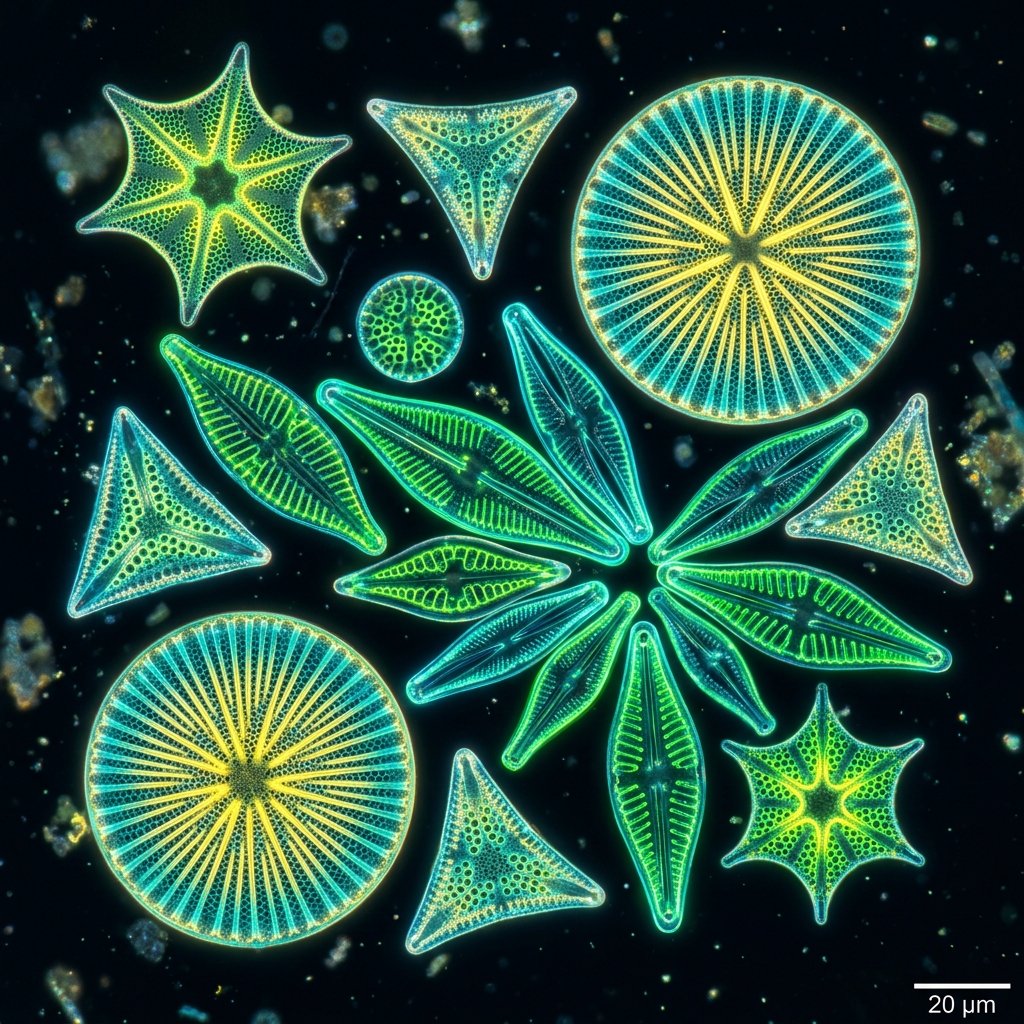
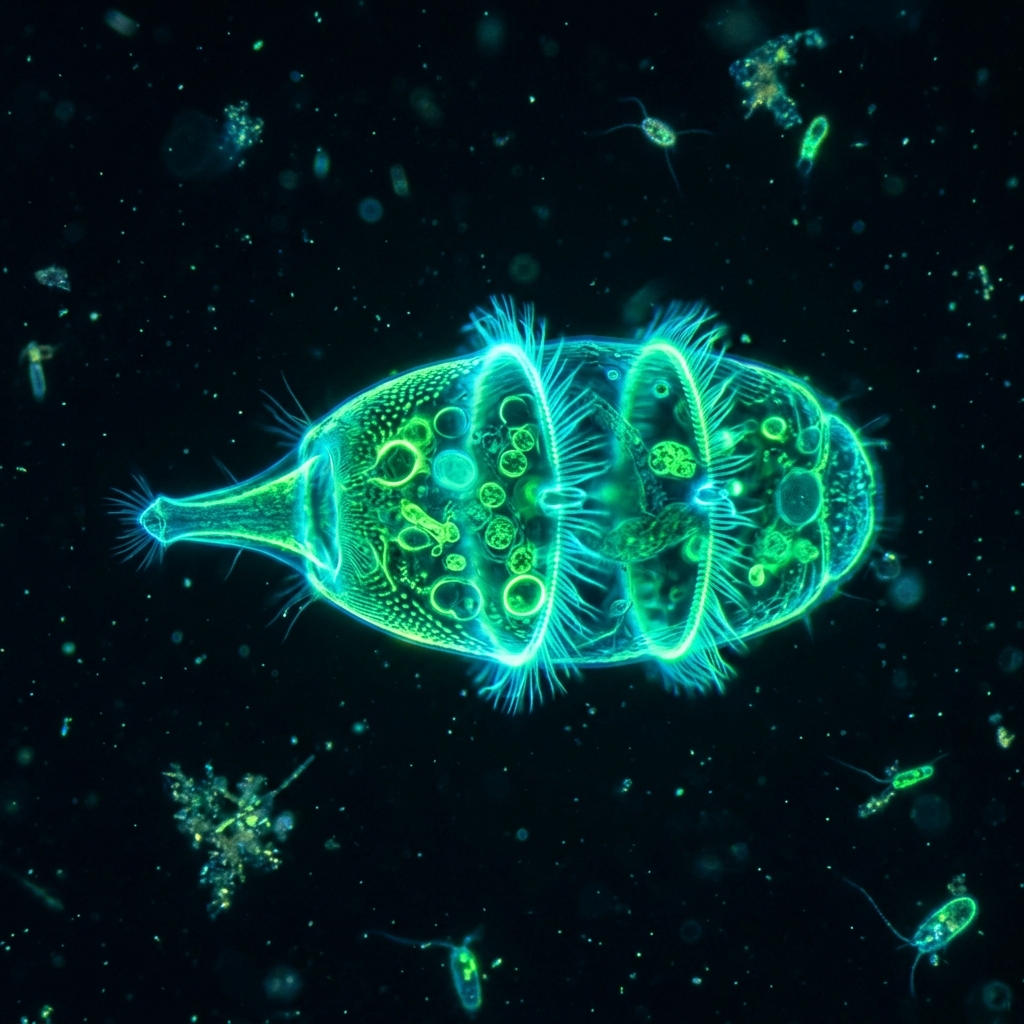
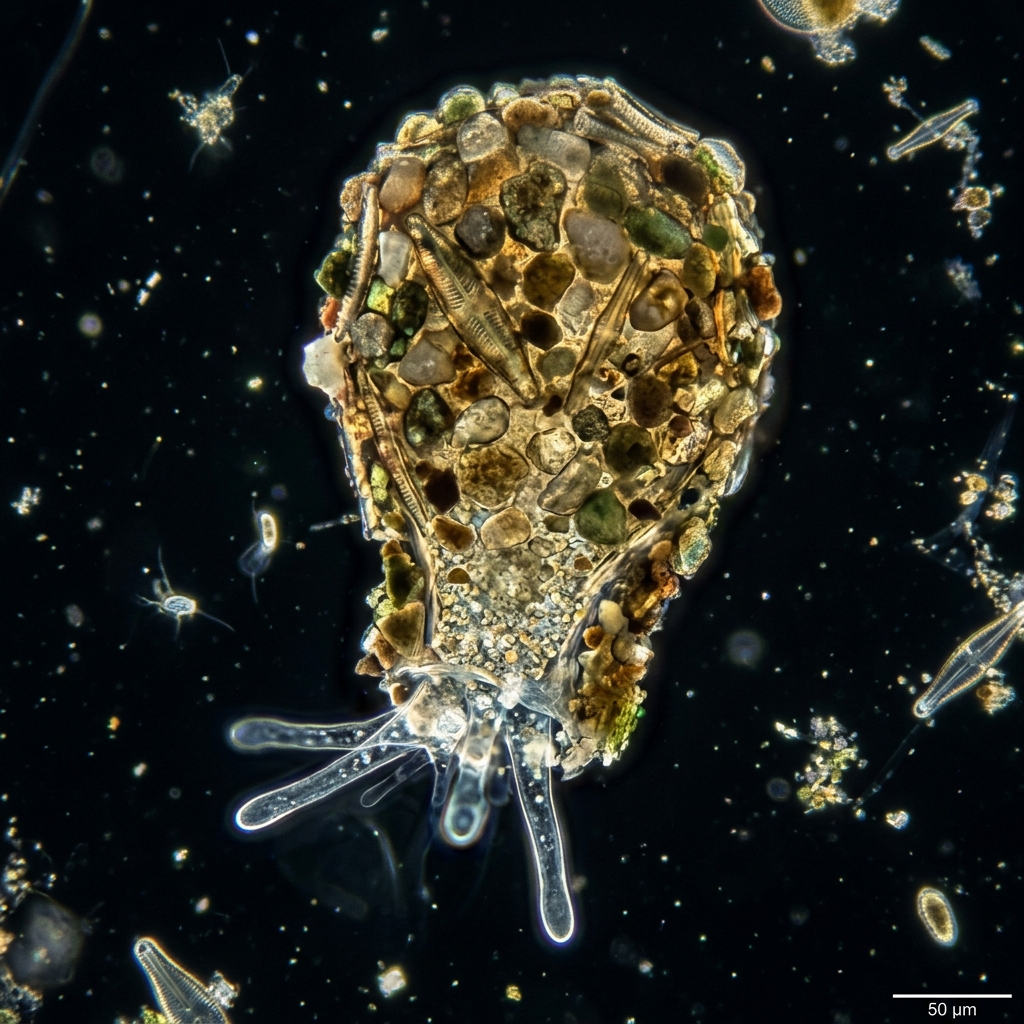
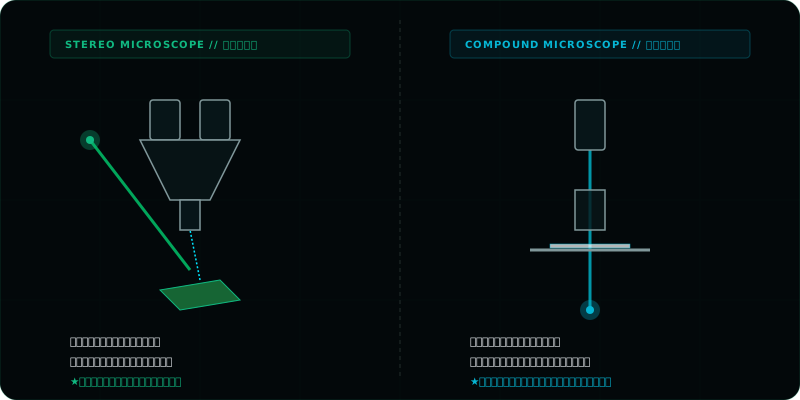
 Figure 1: Comparison between a \"Stereo Microscope\" (left) which shines light from above to view surface textures, and a \"Compound Biological Microscope\" (right) which shines light from below to transmit through the sample.
🎯 Quick Summary & FAQ (Conclusion First)
Before diving into the detailed explanations, here are the most critical takeaways.
Q. Which microscope is the best choice for me? A. It is 100% determined by “what you want to observe.” Choose from the two options below:
- You want to see opaque, three-dimensional specimens like tardigrades, moss, insects, or sand grains. 👉 A [Stereo Microscope] is your best bet because it works at low-to-medium magnification and does not require slide preparation.
- You want to see transparent plankton swimming in water, like Volvox, Paramecia, or Amoebas. 👉 A [Compound Biological Microscope] is correct, as it works at medium-to-high magnification by passing light from underneath through the specimen.
Q. What is the most important feature for smartphone photography? A. “An exposed cylindrical metal eyepiece tube” and “stepless LED brightness adjustment.” Without these, you won’t be able to physically clamp a smartphone adapter securely, and runaway brightness will overexpose your photos into pure white washes.
1. The Two Main Types: Stereo vs. Compound Microscopes
Stepping into the microscopic cosmos, the first major hurdle is selecting the right instrument. Let’s look at the differences between a Stereo Microscope and a Compound Biological Microscope.
Comparison Matrix
| Feature | Stereo Microscope | Compound Microscope |
|---|---|---|
| Main Specimens | Tardigrades, moss, insect wings, minerals, circuit boards | Volvox, Paramecia, Amoebas, plant and animal cells |
| Light Direction | From above (Reflected/Incident light) | From below (Transmitted light) |
| Visual Image | Three-dimensional (3D), lifelike textures | Two-dimensional (2D), transparent cell structures |
| Slide Preparation | Not required (simply place specimen on stage) | Required (using slides and cover slips) |
| Standard Magnification | 10x – 40x (low magnification, wide field of view) | 40x – 1000x (high magnification, ultra-micro world) |
| Phone Shooting Difficulty | ★☆☆☆☆ (super easy optical axis alignment) | ★★★☆☆ (requires precise optical axis alignment) |
2. Three Crucial Selection Points for Stress-Free Smartphone Microscopy
Don’t be fooled by exaggerated advertisements for cheap toy microscopes claiming “2000x magnification!” When shooting with a smartphone, the factors you should prioritize are completely different from choosing a standard microscope.
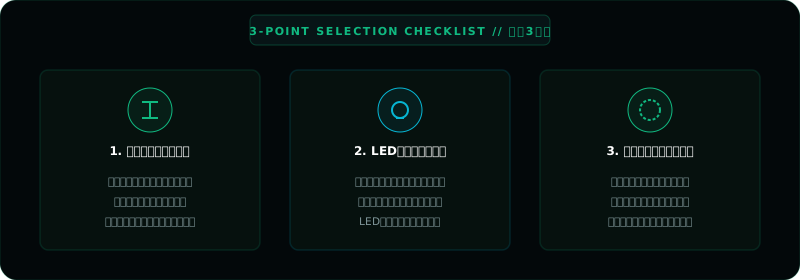 Figure 2: Three physical hardware requirements on a microscope that determine the success of smartphone photography.
The “Big Three” Checklist to Avoid Regret:
- Is the Eyepiece Housing an Exposed, Cylindrical Metal Tube? Educational microscopes with streamlined plastic eyepiece housings lack a proper flat surface to clamp a phone adapter onto, causing it to slip and slide off. Make sure the eyepiece has a straight metal tube with a standard outer diameter sleeve (like 23.2 mm or 30.0 mm).
- Does it Have a Stepless LED Brightness Knob? Models that use a mirror to reflect ambient light are out of the question because they offer zero exposure control for smartphone cameras. To maximize your phone’s sensor performance, a built-in lower LED light source with stepless brightness adjustment is mandatory.
- Is it Equipped with “Coaxial Coarse and Fine Focus Knobs”? At high magnification, the depth of field (the thickness of the area in sharp focus) is only a few microns. A simple coarse adjustment knob will make it incredibly difficult to focus, and the weight of your phone will easily throw it off. A microscope with a fine-focus knob nested coaxially inside a coarse-focus knob will exponentially increase your capture success rate.
3. Tested & Approved: Top 3 Microscopes & Attachments for Smartphone Imaging
We have tested various setups in our lab. The following gear showed outstanding optical axis stability and resolution. Prices are estimated references.
① [Stereo Microscope] Raymay Fujii Binocular Stereo Microscope RXS703
- Features: Low-to-medium magnification (20x/40x) stereo microscope with reflected LED lighting.
- Smartphone Compatibility: ★★★★★
- Why it’s great: Because it is a binocular microscope, you can mount your smartphone clamp to one eyepiece for shooting while using the other eyepiece to observe with your bare eye in real-time. This dual-view setup is unbeatable for hunting down tardigrades hiding in moss.
- Estimated Price: Approx. 18,000 JPY (*For reference only)
- Related Guide: Please also refer to “Selection Points of Hobbyist Biological Microscopes for Beginners”.
② [Compound Microscope] SWIFT Biological Microscope SW200DL
- Features: Heavy metal body, transmitted LED lighting biological microscope supporting 40x–1000x magnification.
- Smartphone Compatibility: ★★★★☆
- Why it’s great: The eyepiece sleeve is a standard cylinder, making adapter clamping seamless. The fine control of the condenser lens and brightness knob completely prevents overexposure during transmitted lighting shoots of Volvox or Paramecia.
- Estimated Price: Approx. 13,000 JPY (*For reference only)
③ [Smartphone Clamp] Vixen Smartphone Camera Adapter
- Features: The definitive alignment clamp from renowned optics manufacturer Vixen.
- Smartphone Compatibility: ★★★★★
- Why it’s great: Unlike cheap plastic mounts, this features ultra-fine metal X-Y axis adjustment screws. You can align your smartphone’s camera lens with the microscope’s optical axis to within a micron simply by turning the adjustment dials.
- Estimated Price: Approx. 5,000 JPY (*For reference only)
- Tips on alignment: “Selecting and Aligning Smartphone Adapters”
4. Three Common Smartphone Microscopy Mistakes & Solutions
Mistake 1: The microscope tips over when the phone is mounted.
- Cause: The base of the microscope is too light (often a plastic toy microscope) compared to the weight of your phone.
- Solution: Select a sturdy model weighing at least 2.5 kg (5.5 lbs) with a heavy metal base, such as cast iron.
Mistake 2: The screen shakes violently, making it impossible to tap the shutter.
- Cause: The vibration from your finger tapping the shutter button is amplified by the high-magnification lens.
- Solution: Use the volume buttons on wired earphones as a physical remote shutter, or use the camera’s built-in 2-second self-timer.
Mistake 3: The adapter slips and rotates around the eyepiece.
- Cause: Oils and dust have accumulated on the metal part of the eyepiece.
- Solution: Clean the exterior of the eyepiece sleeve with an alcohol-soaked lens cleaning cloth to degrease it before re-clamping. See “Selecting and Aligning Smartphone Adapters” for details.
5. FAQ: Frequently Asked Questions on Microscope Selection
Q1. Can I shoot tardigrades with a cheap smartphone macro lens from a dollar store?
Answer: With a simple macro attachment (about 10x–15x magnification), a tardigrade (0.1 mm–0.5 mm in length) will only appear as a tiny speck of dust. You won’t be able to see its legs or movements. To see tardigrades walking and capture their details, you need at least a 20x–40x optical setup on a stereo microscope.
Q2. Is a cheap microscope claiming “2000x magnification” worth buying?
Answer: Absolutely avoid it. The limit of magnification in optical microscopy is determined by the physical “Numerical Aperture (NA)” of the lenses. Digitally magnifying up to 2000x with low-quality plastic lenses only makes the image dark, blurry, and pixelated without adding any real resolution (empty magnification). For home use, a range of 40x–400x (up to 1000x) using high-quality glass lenses yields infinitely sharper and more beautiful images.
Q3. What about digital microscopes with built-in LCD screens?
Answer: While convenient, the internal camera sensors of cheap digital microscopes are inferior to modern smartphone camera sensors and image processing engines. Your phone is much better at capturing smooth videos (e.g., 4K at 60fps) and instantly sharing them. A combination of a “solid traditional microscope + smartphone mount” offers the best image quality and value.
🔗 Related Articles
- 👉 Finding Tardigrades in Balcony Moss: The Ultimate Guide to Rearing and Observation
- 👉 Culturing Volvox: Rearing the Green Spaceship and Observing Asexual Reproduction
- 👉 The Textbook of Smartphone Microscopy: Three Optical Axis Alignment Hacks to Prevent Vignetting and Capture High-Res Images
- 👉 Selection Points of Hobbyist Biological Microscopes for Beginners
- 👉 Plankton Nets and Glass Petri Dish Culturing Kits
- 👉 Selecting and Aligning Smartphone Adapters
- 👉 Bring Out the Details! High-Brightness LED Ring Lights & DIY Lighting Secrets