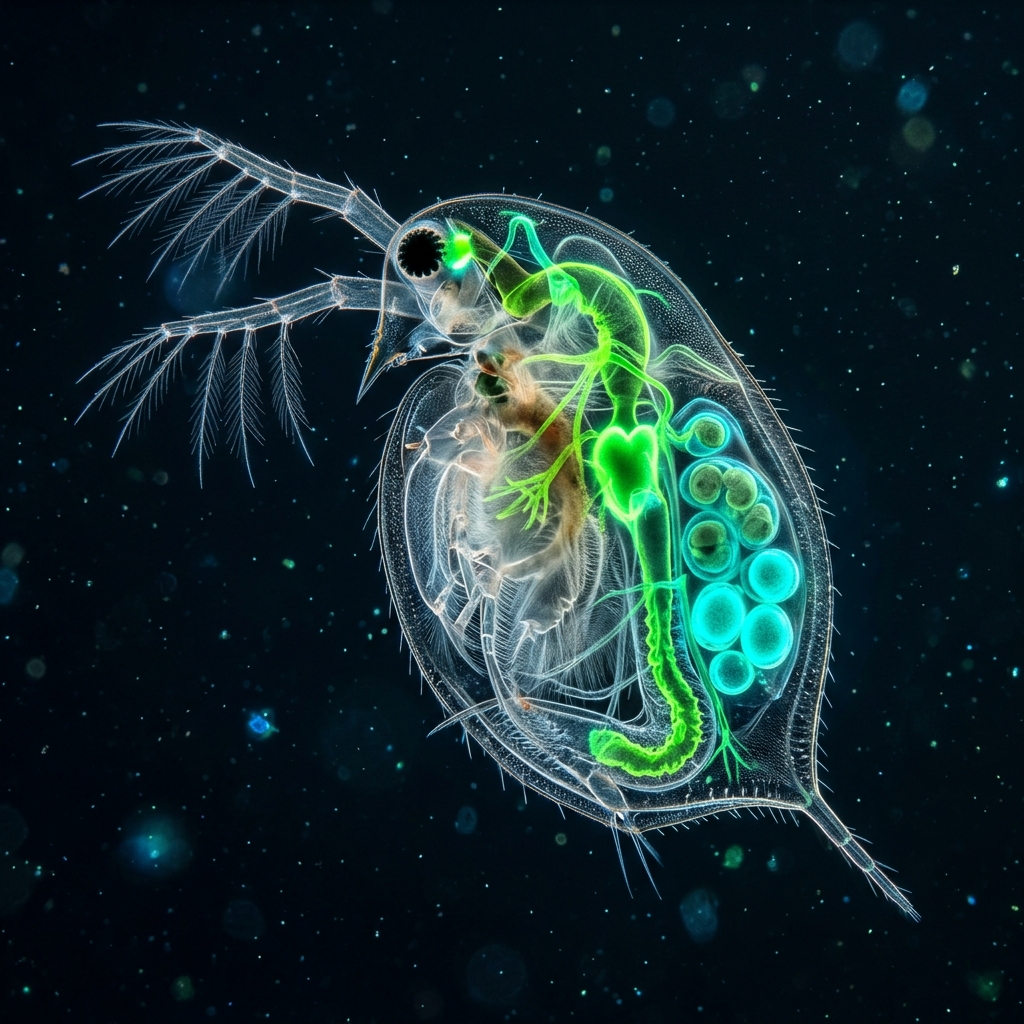
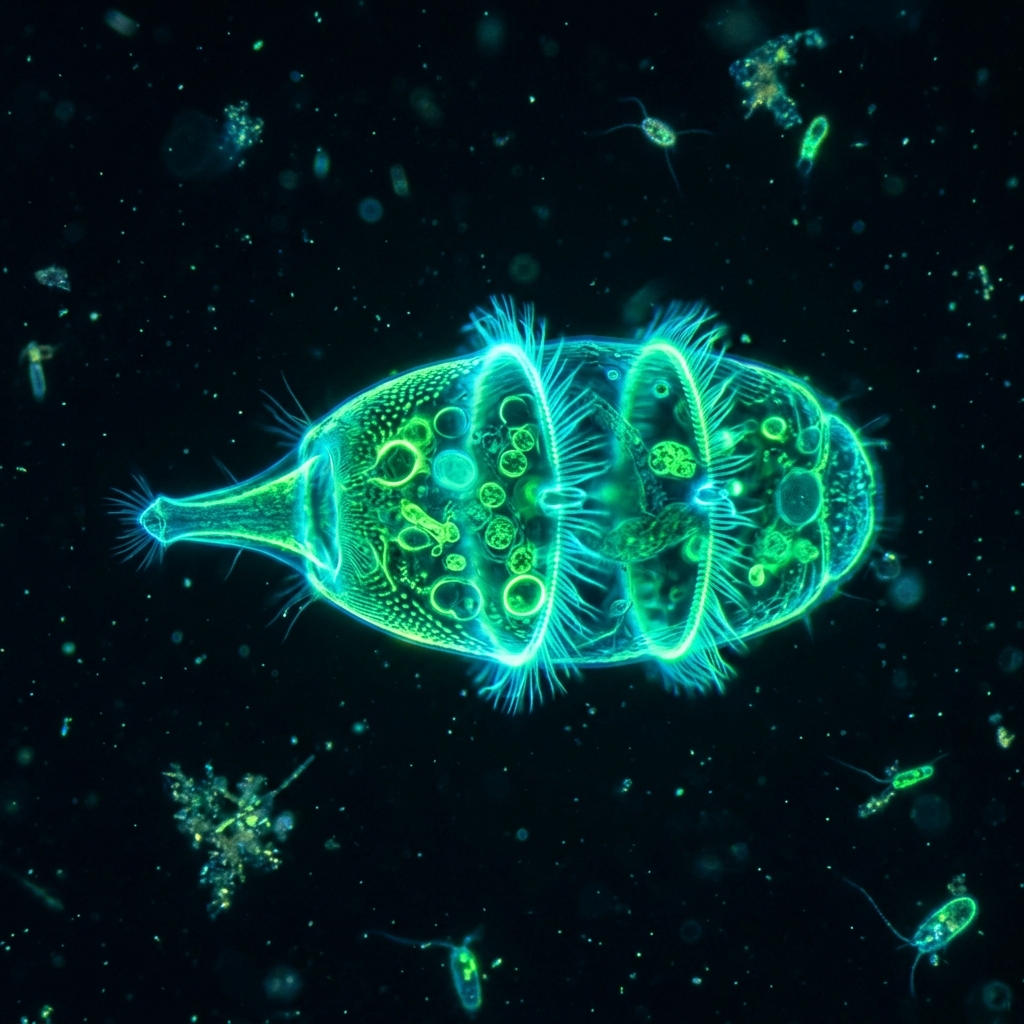
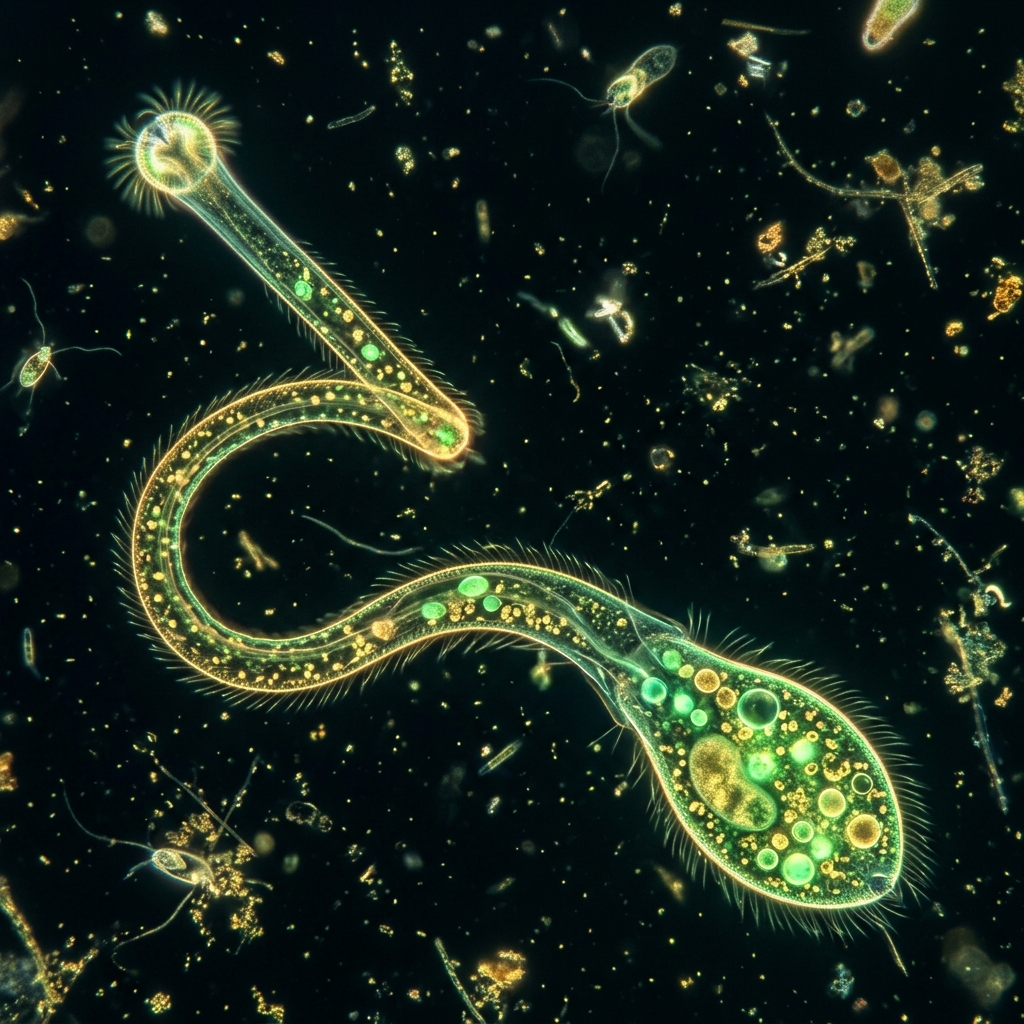
 Figure 1: Lacrymaria olor swimming and crawling under darkfield illumination, extending an extremely long neck from its flask-like body (*Image is for illustrative purposes only).
[!NOTE] *All microorganism images used in this article are 3D CG conceptual images.
🎯 Quick Summary & FAQ (Conclusion First)
Before going into the detailed explanation, here are the key points for observing Lacrymaria olor.
Q. Where can Lacrymaria olor be found?
A. They are abundant in the bottom mud of eutrophic, calm ponds and swamps, or in areas where decaying aquatic plants accumulate.
Since they prefer to move through the gaps of filamentous algae like Spirogyra and detritus (organic sediment), the trick is to scoop up water along with the bottom mud and dead leaves.
Q. What is the most difficult part of observing and photographing them?
A. Their neck extension speed is extremely fast, and they swim around, quickly moving out of the field of view.
Therefore, physical hacks to restrict their movement are essential, such as using a “methylcellulose solution” to increase water viscosity or placing a tiny amount of “cotton fibers” on the slide glass to prevent them from swimming freely.
🔬 1. Ecology and the Amazing Hunting Mechanism of Lacrymaria olor
Among the various hunters in the micro-world, Lacrymaria olor (scientific name) stands out as particularly unique. Meaning “tear” (Lacryma) and “swan” (Olor) in Latin, this single-celled organism (ciliate) features a beautiful tear-drop-shaped cell body and a long neck reminiscent of a swan.
The Mystery of the Cytoskeleton Enabling an Extension of Over 10x Body Length
The most characteristic behavior of Lacrymaria is the dynamic extension of its neck. While its tear-drop-shaped body is normally only 40–100 µm, its neck can stretch to 1.2 mm (1200 µm) or more when searching for prey.
- The Secret of Ultra-Stretchability: Right beneath the cell membrane lies a network of protein fibers called “microtubules” (helical microtubule bundles) aligned in a spiral pattern. By expanding and contracting this helical structure like an accordion, Lacrymaria can extend its neck extremely rapidly and flexibly.
- Deadly Hunting: The tip of the neck features a bulge called the “head,” equipped with stinging organelles (toxicysts) to paralyze prey. The moment the head contacts a target—such as other small ciliates like Coleps or Colpidium—it paralyzes the prey with toxicysts, opens its mouth wide, and swallows it whole.
2. Collection and Screening Procedures from Nearby Waters
Because Lacrymaria is very difficult to culture, the standard method is to scan and find them within water samples collected from the wild.
Promising Spots and Sampling Methods
| Collection Site | Expected Reason | Sampling Hack |
|---|---|---|
| Bottom of established ponds with lush water plants | Small ciliates (prey) are abundant, and it is easy to hide from predators. | Do not sample the water surface; target the mud and detritus near the roots of water plants using a dropper. |
| Park ponds with sunken fallen leaves | Humic decomposition promotes bacterial growth, generating a food chain. | Gently shake and wash decaying leaves with slightly slimy surfaces in the water and collect that water. |
| Gutters with accumulated Spirogyra | Spirogyra fibers serve as excellent “scaffolds” for Lacrymaria. | Bring home a handful of Spirogyra in a bottle along with a small amount of pond water. |
Slide Preparation and Screening
- Let the collected muddy water bottle stand for about a day, then use a dropper to draw water from just above the settled mud.
- Spread it thinly in a flat Petri dish and scan the whole dish under a microscope or stereomicroscope at low magnification (40x to 100x).
- If you find a “flask-shaped creature rapidly extending and contracting its neck in all directions” at the edge of the field of view, that is Lacrymaria.
3. Microscope Observation & Photography Hacks: Capturing the Fast-Moving Neck
Lacrymaria is incredibly active and never stays still. To capture its beautiful cell structure or the moment of predation at high magnification (200x to 400x), the following microscope hacks are highly effective.
Hack A: Viscosity Restriction with Methylcellulose
After dropping the sample water onto the slide glass, add one drop of commercial “methylcellulose solution” (approx. 1–2% concentration). This increases the viscosity of the water, dramatically slowing down Lacrymaria’s swimming speed. The neck extension speed also slows down moderately, making it easier to focus and enabling long-term observation and beautiful photography.
Hack B: Cotton Fiber Cage Method
If you do not have methylcellulose, place a few strands of “cotton fibers” teased apart with tweezers onto the slide glass, drop the sample water on top, and apply the cover slip. The jungle of cotton fibers acts as a maze, trapping Lacrymaria and temporarily restricting its movement. Because they still actively extend their necks in this state, it creates the perfect setup for photographing the extending neck locally.
Hack C: 3D-like Observation with Darkfield Illumination
Since Lacrymaria’s cell body is nearly colorless and transparent, its outline tends to blur under normal brightfield illumination. By inserting a darkfield patch (or a simple DIY darkfield filter) under the stage, the background becomes jet black, causing Lacrymaria’s spiral cilia and extending neck to stand out beautifully as if glowing on their own.
🔗 Related Articles
- 👉 The Armored Sweeper: Characteristics and Culturing of Coleps | The Microscopic Decomposers of Dead Plankton
- 👉 The Beast of the Micro World: Didinium Culturing and Hacks for Observing Dynamic Paramecium Predation
- 👉 Smartphone Microscope Photography Guide: 3 Optical Axis Alignment Hacks to Prevent Vignetting and Get High-Quality Images
- 👉 Microscope Photos as Art! Lighting Hacks for Dramatic Changes Using Darkfield, Polarization, and 100-Yen Shop Materials
- 👉 Overcoming Depth of Field! Focus Stacking (Multifocal Fusion) on Smartphones